The Most Expensive Discount in Higher Ed
November 3rd, 2026
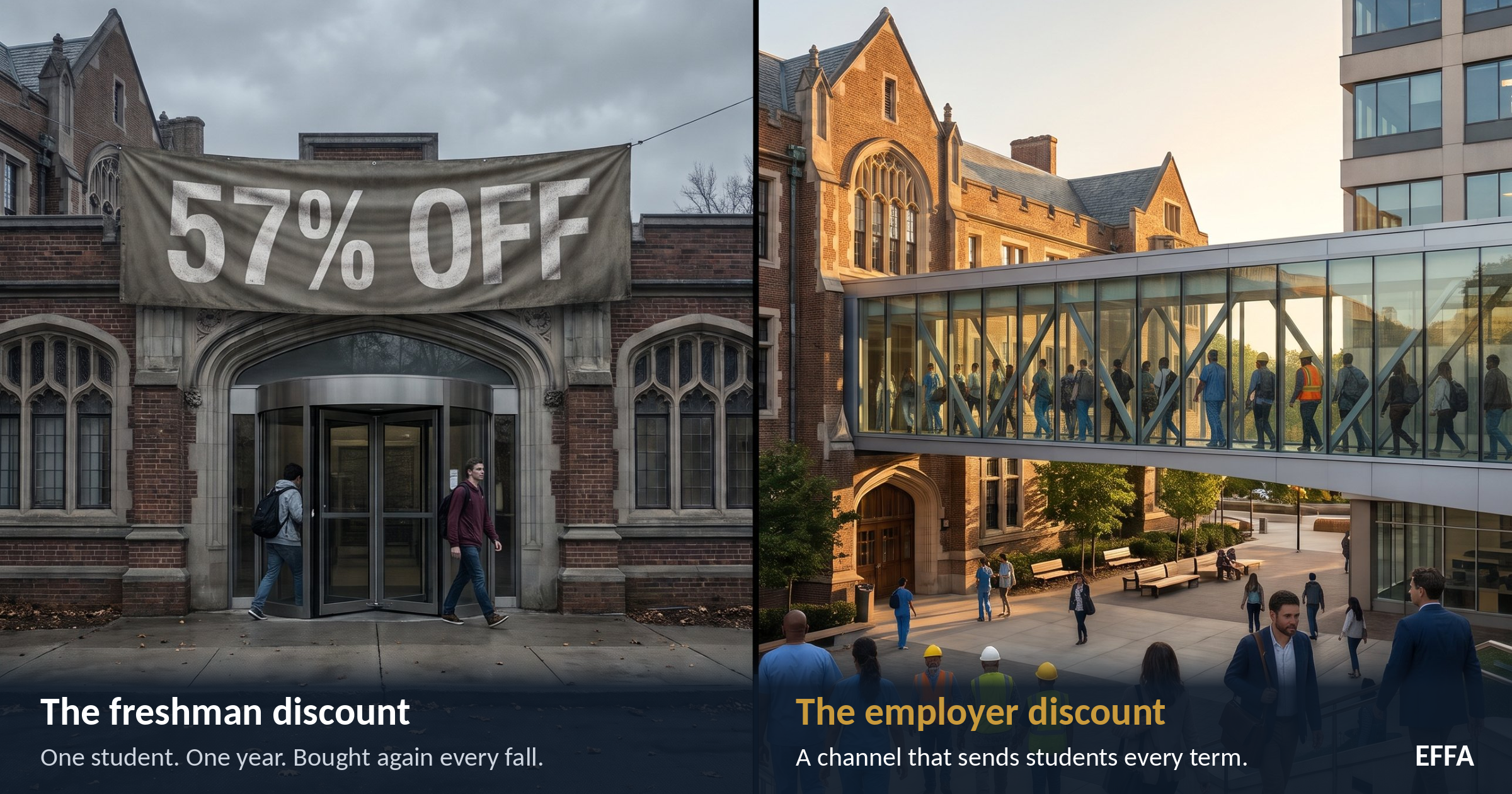
Private colleges now give away more than half of their tuition to win each new student, and collect less every year doing it. There is one discount that buys something lasting, and most schools treat it as a cost.
The short answer: the average private nonprofit college discounted tuition for first-time undergraduates by 57.1% in 2025-26, a record, according to preliminary NACUBO figures. That discount buys one student for one year, and it has to be bought again every fall. An employer partnership discount, even a large one, buys something different: a channel that keeps sending students, often paid for by the employer, who stay enrolled longer and cost almost nothing to recruit.
Key numbers at a glance:
Average tuition discount rate, first-time undergraduates: 57.1% (2025-26, preliminary), up from 54.5% a year earlier
Average discount rate, all undergraduates: 51.3%
First-time students receiving institutional aid: 90%
Net tuition revenue per first-time, full-time student: down 2.2% after inflation in 2024-25
Tax-free employer tuition benefit: up to $5,250 per employee per year under Section 127, indexed to inflation from 2027
What is the average tuition discount rate in 2026?
At private nonprofit colleges, it is 57.1% for first-time undergraduates and 51.3% for all undergraduates, according to NACUBO's latest Tuition Discounting Study, based on 258 institutions. The first-year rate is the highest in the past decade, up from 54.5% just a year earlier.
Put plainly, the average first-year student at a private nonprofit pays well under half of the published price. Ninety percent of them receive institutional aid. And the money left over is shrinking: after inflation, net tuition revenue per first-time, full-time student fell 2.2% in 2024-25.
Schools are giving away more and collecting less. That is not a pricing strategy. It is a treadmill.
What does a tuition discount actually buy?
An institutional discount buys one thing: a single student's enrollment decision, for one year.
Then it has to be bought again. Next fall's class needs its own discount, and it will probably need a bigger one, because every competing school is running the same play for the same students. The rate went from 54.5% to 57.1% in a single year. Nobody in that arms race is buying an advantage. They are paying to stand still.
And the pool they are competing for is shrinking. U.S. high school graduates peaked with the class of 2025 and are projected to fall about 13% by 2041. More discount chasing fewer students is a strategy with one direction.
How is an employer partnership discount different?
It buys a channel instead of a student. Many schools already offer a tuition discount to the employees of partner organizations, and those discounts are not always small. Published examples include 10% at DePaul, 20% on most programs at Webster University and 25% on graduate programs at Creighton. Many of the schools we work with go much further, discounting by more than 50%. Some go as far as setting total annual tuition at $5,250, the tax-free limit, so an employee whose employer offers the benefit pays nothing out of pocket.
That is a discount as deep as the freshman discount. But look at what it buys:
A relationship that keeps sending students. One employer agreement can produce enrollments every term, for years, without the school winning each student from scratch
A student whose tuition the employer pays. Employers can pay up to $5,250 a year per employee tax-free under Section 127, and that cap starts rising with inflation in 2027
A student who costs almost nothing to recruit. The CEO of Strategic Education, parent of Strayer and Capella, told investors this year that for students arriving through its employer platform, "there's almost no acquisition cost"
A pool that isn't shrinking. Working adults aren't part of the demographic cliff, and most of them already have a tuition benefit they never use. We covered why in Which Genius Designed the Reimbursement Process for Tuition Benefits?
A freshman discount is a cost of acquiring one student. An employer discount is an investment in a channel.
Do employer-funded students stay enrolled longer?
Yes. The research points the same way: students whose employers pay stay enrolled and finish at higher rates.
Community colleges: a matched-comparison study in the Journal of Student Financial Aid found that students receiving Section 127 employer educational assistance had "better retention and attainment outcomes" than a comparable group without it
Ivy Tech Community College: a RAND evaluation of its Achieve Your Degree employer program found participants had more than 50% higher odds of completing a short-term certificate, even after accounting for prior academic performance
It makes sense. An employer-funded student has a reason to finish that a discount can't buy: an employer invested in them, a job that uses what they're learning, and no tuition bill hanging over the next term. For a school, that means the employer discount pays back twice: once when the student enrolls, and again every term they stay.
Why do schools treat the employer discount as a cost?
Because that is how the budget shows it. The employer discount appears as revenue the school gave up, with nothing on the other side of the ledger. Nobody owns the employer relationships, so nobody is measured on the students they produce. And when an employee has to pay first and wait to be reimbursed, the benefit goes unused and the discount looks like it bought nothing.
There is also no benchmark. A school can tell you its freshman discount rate to the decimal. Almost none can tell you how many students each employer partner sent last year, what each one cost to enroll, or how many stayed. A discount nobody measures is a discount nobody can defend in a budget meeting.
What should schools do instead?
Count what you already give away. Put your institutional discount next to your employer partnership discount. Most cabinets have never seen the two numbers side by side
Treat employer discounts as a channel investment, with terms. Decide which employers get which terms, and why. We wrote about where schools actually have a right to win in Market View vs. Market Access
Measure it like a channel. Students per partner per year, cost per enrolled student, retention. Give it an owner and a number
Make it easy for the employer to pay. If the employee has to front the tuition, the discount never gets used. Billing the employer directly removes that barrier
Tell your partners what is changing. The Section 127 cap rises from 2027. Our Section 127 Q&A covers what employers need to know
Every school is already spending enormous sums on discounts. The question isn't whether to discount. It's whether any of that discount buys something that lasts. For any school asking where the next dollar comes from, my answer hasn't changed: employers, employers and employers.
Frequently asked questions
What is a tuition discount rate?
It is the share of a college's gross tuition and fee revenue that it gives back to students as institutional grants and scholarships. A 57% discount rate means the school collects, on average, 43 cents of every dollar of published tuition from first-year students.
What is an employer partnership discount?
A tuition discount a school offers to employees of a partner organization, usually as part of a formal partnership agreement with that employer. Examples published by schools such as DePaul, Webster and Creighton range from 10% to 25%, and some schools set tuition at the $5,250 tax-free limit so employees pay nothing.
How much can an employer pay toward an employee's tuition tax-free?
Up to $5,250 per employee per year under Section 127 of the tax code. Starting in 2027, that limit adjusts for inflation. See What Is the Section 127 Limit for 2027?
EFFA helps schools build employer-funded enrollment as a channel they can run, and lets employers pay schools directly. To see the platform, request a demo. For help deciding which employers to pursue and on what terms, start with EFFA Advisory.
Sources
Higher Ed Dive, Tuition discount rate reaches 57% for private nonprofits, NACUBO says (June 1, 2026)
Higher Ed Dive, WICHE projections: high school graduates peak in 2025 (Jan 27, 2025)
Creighton University, corporate partnership tuition discount
IRS Publication 15-B (2026), Employer's Tax Guide to Fringe Benefits
Strategic Education, Q2 2026 earnings call transcript (July 29, 2026)