What Is the Section 127 Limit for 2027?
October 22nd, 2026
Last checked October 20, 2026.
The short answer: for 2026, the Section 127 limit is $5,250 per employee. That is the most educational assistance an employer can give an employee tax-free in a year. Starting in 2027, the limit adjusts for inflation for the first time since 1986. As of October 20, 2026, the IRS has not announced the 2027 amount.
Status at a glance:
2026 limit: $5,250, final
2027 limit: indexed to inflation, not yet announced by the IRS
How it will be set: the tax-bracket inflation formula, measured from 2025 and rounded to the nearest $50
Student loan payments: permanent, and inside the same cap
Many employers and schools do not know this is changing. Some do not know Section 127 exists at all. So here is the whole picture in one place.
What is Section 127?
Section 127 lets an employer pay for an employee's education without that money counting as the employee's income. It is the reason a $5,250 tuition benefit does not count as wages on a W-2.
It applies to the employee's own education, undergraduate or graduate
The course does not have to be related to the employee's current job
It covers tuition, fees, books, supplies and equipment
It can also cover payments on the employee's own student loans (more on that below)
It requires a written plan. No plan, no exclusion
What is the Section 127 limit for 2026?
$5,250 per employee, per calendar year. That one number covers tuition and student loan payments combined. If an employer pays $2,000 toward an employee's loan, only $3,250 more can go toward tuition tax-free that year.
Unused amounts do not carry over. The cap resets every January.
Within the limit, the benefit is exempt from federal income tax withholding, Social Security and Medicare taxes, and federal unemployment tax, according to the IRS's 2026 fringe benefits guide. Up to the limit, that means no federal payroll tax on either side: not for the employee, and not for the employer.
Is $5,250 the employer's spending limit or the employee's tax exclusion?
It is the employee's tax exclusion, not a cap on what an employer may spend. An employer can pay more than $5,250 a year toward an employee's education. The amount above the limit is generally taxable wages unless it qualifies as a working condition benefit, covered below.
Has the IRS announced the 2027 Section 127 limit?
Not yet. As of October 20, 2026, the IRS had not announced the 2027 amount. The IRS announces inflation-adjusted figures each fall; for 2026, it announced them on October 9, 2025. We check for the announcement and will update this page when the IRS publishes it.
How will the 2027 Section 127 limit be calculated?
The IRS will raise the $5,250 cap by one year of inflation, measured with the same chained consumer price index used for the tax brackets, starting from 2025 and rounded to the nearest $50. In detail:
The law changed on July 4, 2025. The One Big Beautiful Bill Act (Public Law 119-21) added a new inflation adjustment to Section 127 for taxable years beginning after 2026
The adjustment uses the same cost-of-living formula as the tax brackets, which runs on the chained consumer price index, averaged over the 12 months ending August 31
The starting point is 2025. Inflation is measured from 2025 forward, not from 1986
Increases are rounded to the nearest $50. The limit will move in $50 steps, so the new figure will end in 00 or 50, never something like $5,327
Because the adjustment tracks a single year of inflation and rounds in $50 steps, the first increase will be modest. Think tens or low hundreds of dollars, not thousands.
Why hasn't the limit changed since 1986?
Because until 2025, nothing in the law told it to.
1978: Congress created Section 127 as a temporary provision
1984: Congress set a $5,000 annual limit
1986: The Tax Reform Act raised it to $5,250
2013: The American Taxpayer Relief Act of 2012, signed in January 2013, made the provision permanent after decades of short-term renewals
2020: Employer payments on student loans were added, temporarily
2025: Student loan payments were made permanent and the cap was indexed to inflation from 2027
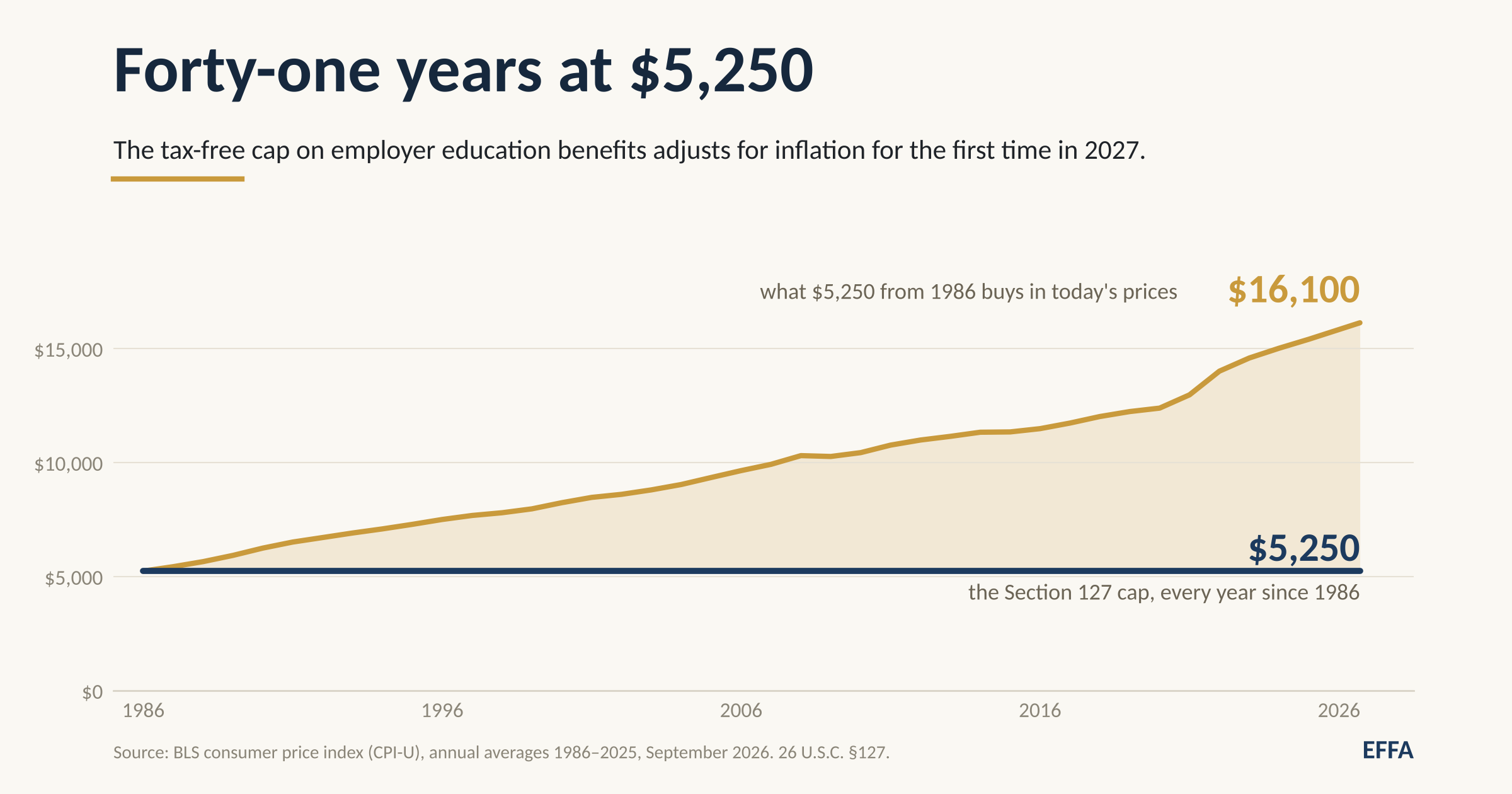
For forty-one tax years, 1986 through 2026, the cap sat still while prices did not. $5,250 in 1986 had the buying power of about $16,100 today, comparing the 1986 annual average of the Bureau of Labor Statistics consumer price index for all urban consumers (CPI-U) with its September 2026 reading. That is a purchasing-power illustration, not the formula the IRS uses for indexing. In real terms, the benefit has lost about two-thirds of its value.
Indexing stops that erosion. It does not reverse it. Because the formula measures inflation from 2025, the purchasing power lost between 1986 and 2025 is not coming back. The cap will now keep pace with prices. It will not catch up to them.
Does Section 127 cover student loan payments?
Yes, and that is now permanent. For payments made after March 27, 2020, an employer can pay principal or interest on an employee's qualified education loan under a Section 127 plan. That provision was set to expire at the end of 2025. The 2025 law removed the expiration date.
The loan can be federal or private
The loan can predate the job. It does not matter when the employee borrowed
The employer can pay the lender directly or pay the employee
Loan payments share the same annual cap as tuition. They are not an extra $5,250
An existing plan usually needs an amendment to add loan payments. A plan already written to cover everything Section 127 allows may not.
What does Section 127 not cover?
Meals, lodging or transportation
Tools or supplies the employee keeps after the course, such as a laptop. Textbooks are the exception
Courses involving sports, games or hobbies, unless they relate to the employer's business or are required for a degree
Spouses and dependents, unless they are employees in their own right
What does an employer need to offer a Section 127 plan?
A separate written plan, for the exclusive benefit of employees. The IRS publishes a sample plan, Publication 5993
Notice. Eligible employees must be told the plan exists and what its terms are
Fair eligibility. The plan cannot favor highly compensated employees or their dependents
A limit for owners. People owning more than 5 percent of the business, with their spouses and dependents, can receive no more than 5 percent of the year's total benefits
No cash alternative. Employees cannot be offered a choice between the benefit and taxable pay
No funding requirement. The plan does not need a trust or a separate account
What happens if an employer pays more than the limit?
Anything above the limit is generally taxable wages. The main exception is a working condition benefit: if the education would have been a deductible business expense had the employee paid for it, it can be excluded regardless of amount. Job-related training often qualifies. A degree outside the employee's current field usually does not.
Does the employee have to pay first and get reimbursed?
No. Nothing in Section 127 requires reimbursement. The law defines educational assistance as the employer's payment of education expenses incurred by or on behalf of the employee. An employer can pay the school directly.
Reimbursement is a policy choice, not a legal one. It is also one of the biggest reasons eligible employees never use these benefits: an employee who cannot float a semester's tuition cannot use a benefit that pays them back after the grades are in. We wrote about that in Which Genius Designed the Reimbursement Process for Tuition Benefits?
The One Big Beautiful Bill Act and Section 127: a quick Q&A
What did the 2025 law change in Section 127?
Two things. It made employer payments on student loans permanent, and it tied the $5,250 cap to inflation starting in 2027.
When was it signed?
July 4, 2025, as Public Law 119-21. The Section 127 changes are in Section 70412.
Is this the same law the IRS calls the Working Families Tax Cuts?
Yes. The IRS uses that name for the 2025 law on its own guidance pages, so you will see both.
When does each change take effect?
The student loan change applies to payments made after December 31, 2025. The inflation adjustment applies to taxable years beginning after 2026, which for most employees means calendar year 2027.
Does the law change the 2026 limit?
No. The limit for 2026 is $5,250.
Does the inflation adjustment apply to student loan payments too?
Yes. Tuition and loan payments share one annual cap, and that single cap is the one being indexed.
Did the law change who qualifies or what a plan must include?
No. The written-plan, notice, fair-eligibility and owner rules are unchanged, and so is the list of covered expenses.
Do employers need to amend their plans?
To add student loan payments, usually yes, according to the IRS. For the new limit, it depends on whether the plan names a fixed dollar figure. Benefits counsel can tell you which applies to yours.
What should employers and schools do before January?
Employers:
Check how your plan states the limit. A plan that says "$5,250" in so many words will keep paying $5,250 after the limit rises, unless you amend it. A plan that refers to the Section 127 maximum will move with the law
Decide whether you will raise your benefit to match. Indexing raises what the law allows. It does not raise what your plan pays
Look at loan repayment. It is permanent now, and it shares the same cap
Look at how the money moves. If employees front the tuition today, ask how many eligible people actually use the benefit
Schools:
These changes are one of three tailwinds behind employer-funded enrollment right now. We wrote about all three, and how to get started, in Employer-Funded Enrollment: Three Tailwinds for 2027.
Update every page that says $5,250. Your employer-partnership pages, your adult-learner pages, your financial aid pages. Prospective students search this number
Tell your employer partners. A school that explains the change before the employer's benefits team does is a school that gets the next conversation
Offer to bill the employer directly. It is the simplest way to turn an unused benefit into an enrolled student
How EFFA fits
EFFA is a direct-bill platform for employer-funded tuition. The school invoices the employer through EFFA, the employer approves and pays, and the employee never fronts the tuition. Employers pay EFFA nothing. For how direct billing works from the employer's side, see our Employer FAQ.
EFFA does not determine tax treatment. Whether a payment qualifies under Section 127 depends on the employer's own plan and tax position. This page is general information, not tax advice.