Employer-Funded Enrollment: Three Tailwinds for 2027
October 22nd, 2026
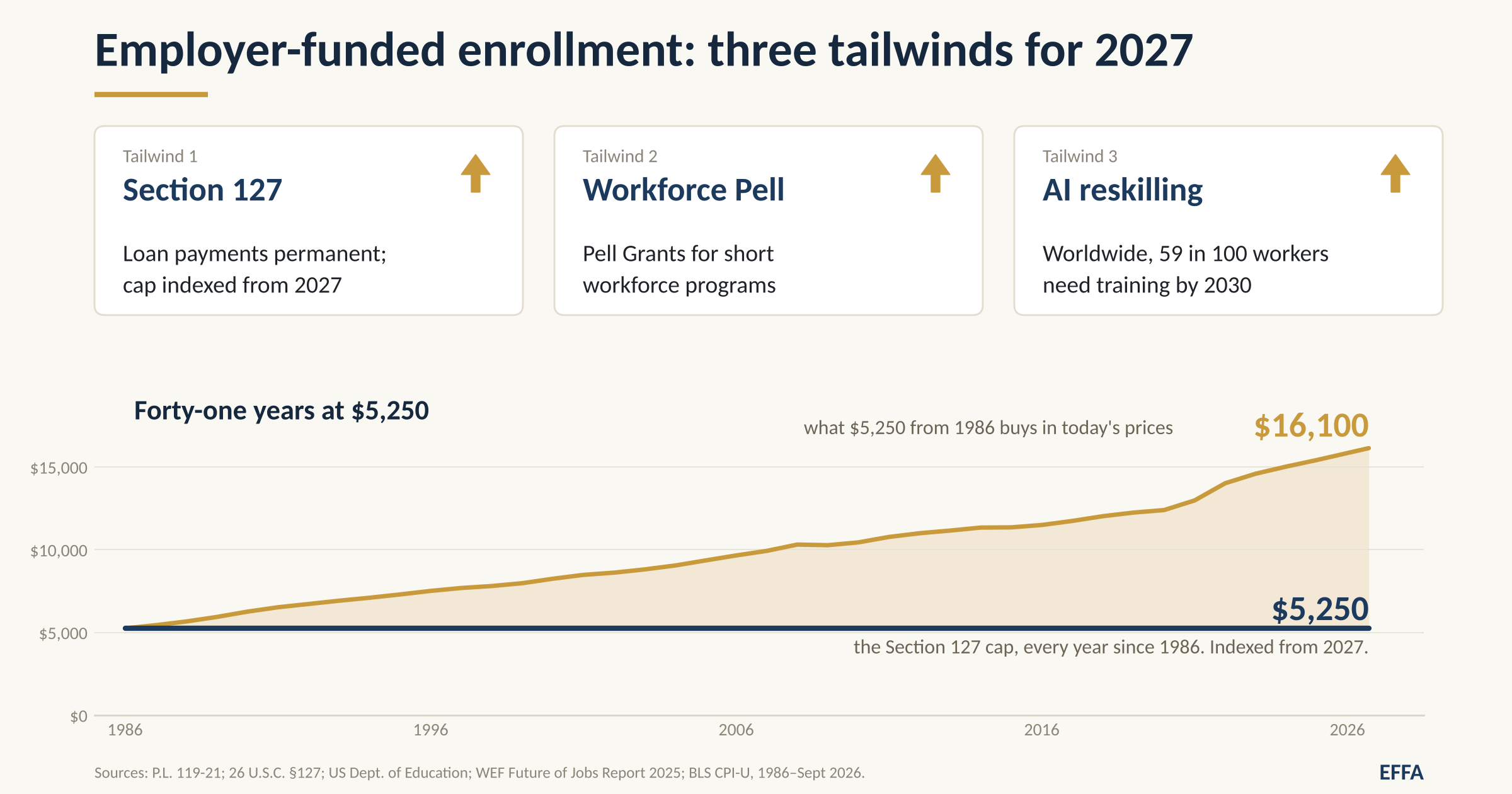
Schools have three new tailwinds with employers heading into 2027, and two of them come from one law. The One Big Beautiful Bill Act was signed into law on July 4, 2025. Most of the coverage went to taxes and the federal budget. Inside it are two changes that matter a great deal to any school that works with employers, and both are taking hold now:
It made employer student loan payments under Section 127 permanent, and indexed the $5,250 tax-free cap to inflation starting in 2027
It created Workforce Pell, Pell Grants for short workforce programs, which opened on July 1, 2026
Add a third force the law did not create, AI sending workers back to learn, and three tailwinds are now pushing in the same direction: toward employers paying for their people's education, and toward the schools ready to receive it.
The employer channel does not usually get good news. For most of my career, the federal rules around employer-funded education rarely moved. This year they moved at once.
Tailwind 1: The employer tuition benefit now covers student loans for good, and it grows with inflation
Section 127 of the tax code lets an employer pay up to $5,250 a year toward an employee's education, tax-free. The law changed it in two ways.
Employer payments on student loans are now permanent. That provision had been set to expire at the end of 2025. An employer can pay tuition, pay down an employee's existing student loans, or both, under the same benefit and the same cap, with no end date
The $5,250 cap adjusts for inflation starting in 2027. It has not moved since 1986
The first increase will be modest, because the formula measures one year of inflation and rounds in $50 steps. What matters is direction. For four decades the benefit lost value nearly every year. What $5,250 bought in 1986 would take about $16,100 today. Starting in 2027, the cap rises with inflation instead of falling behind it.
It is also a generous benefit by design. Up to the limit it is free of federal income tax and federal payroll tax, for the employee and the employer alike, and the course does not have to relate to the employee's current job.
We put together a plain-language guide to the changes, including how the 2027 limit will be set and when the IRS is expected to publish it: What Is the Section 127 Limit for 2027?
Tailwind 2: Pell Grants now reach short workforce programs
Created by the same law, Workforce Pell opened on July 1, 2026: Pell Grants for eligible students in short, approved programs tied to high-skill, high-wage or in-demand jobs. The Education Department has highlighted career and technical education and registered apprenticeships as priorities. Each state's governor, working with the state workforce board, identifies the fields that qualify. Eligible programs run at least eight weeks and fewer than 15.
These are the kinds of programs many employers hire from. For a school with a strong certificate portfolio, it is a new federal door into training that employers already value, and a reason to put those programs in front of employers by name.
Tailwind 3: AI is sending workers back to learn
The World Economic Forum surveyed employers for its 2025 Future of Jobs Report. They expect 39 percent of workers' existing skills to be transformed or become outdated by 2030, and 85 percent plan to prioritize upskilling their workforce. By WEF's estimate, if the world's workforce were 100 people, 59 would need training by 2030.
Workers feel it too. In Pew's survey of more than 5,000 US workers, 52 percent said they were worried about the future impact of AI use in the workplace.
People argue about how much AI is changing jobs today, and the research is genuinely split. But the demand to learn is not waiting for that argument to settle. Workers want new skills, employers say they plan to build them, and someone is going to teach those courses.
Employers are also getting more learning out of fewer dollars. ATD found direct training spend fell to $846 per employee in 2025, down about a third from 2024, while formal learning hours went up. An employer in that position wants every development dollar to go further, and a tax-free tuition benefit paid straight to a school is built for exactly that.
Why this moment, and why schools should move first
Tailwinds reward whoever is ready to use them. The schools that are prepared to capture these will have a tremendous advantage right out of the gate, and the gate opens in January. Three reasons not to wait:
The 2027 limit takes effect in January. Every employer with a tuition benefit will be asking what changed. The school that explains it first is the school that gets the next conversation
Employers are planning next year now. For many employers, next year's budgets and benefit plans take shape in the fall. A school that shows up after those decisions are made is selling into the following year's plan
The proof is already public. Strategic Education, a publicly traded university operator, reported that employer-affiliated students reached 34.7 percent of enrollment in its US Higher Education segment in the second quarter of 2026, an all-time high. Few schools report anything close to that, which leaves the room open for the school that moves now
What it takes to get started
The schools that turn these tailwinds into enrolled students all solve the same four things: strategy, partnership formalization, onboarding and day-to-day operations. A practical first pass:
Pick the programs that solve an employer's problem. Start with the two or three programs tied to roles employers in your region cannot fill. Lead with those, not with the catalog
Build the right target list. Skip the national logos everyone else is calling. The employers most likely to say yes are the regional ones large enough to fund tuition and close enough to know your name, and your alumni already work at many of them. We wrote about that in Everyone Is Calling the Same Thousand Companies
Lead with what changed. The Section 127 changes give you a reason to call that is about the employer, not about you. Use it
Formalize the partnership. A signed agreement is not a channel. Decide who owns the relationship, what the terms are, and what happens at every handoff after the signature
Make it easy for the employer to pay you directly. When an employee has to pay first and wait to be reimbursed, the upfront cost alone can keep them from using the benefit. Billing the employer directly removes that gate. More on why in Which Genius Designed the Reimbursement Process for Tuition Benefits?
Update every page that says $5,250. Your employer-partnership pages, your adult-learner pages and your financial aid pages. People are searching that number
Then measure it like a channel: who owns it, how many employers are active, how many students they fund. A campaign has a season. A channel has a number somebody is accountable for.
For any school asking where the next dollar comes from, the answer has not changed: employers, employers and employers. It just got three tailwinds behind it.
Read next: our plain-language Q&A on the Section 127 changes, including how the 2027 limit will be set and what employers and schools should do before January: What Is the Section 127 Limit for 2027?
EFFA helps schools build employer-funded enrollment as a channel they can run, and lets employers pay schools directly. To see the platform, request a demo. For help with the strategy, start with EFFA Advisory.