Everyone Is Calling the Same Thousand Companies
September 28th, 2026
Ask a college president what happened to enrollment this year and you will usually get one of two answers. The demographic cliff. Or AI, summarizing search results before anyone reaches an inquiry form.
Both of those are real. Neither one explains what actually happened.
Start with the cliff, because it is the older answer and the easier one to check. Total postsecondary enrollment grew 1.0 percent in fall 2025. Undergraduate enrollment rose 1.2 percent. Community colleges were up 3.0 percent and public four-years up 1.4 percent.
Private nonprofit four-year institutions were down 1.6 percent.
Read those two facts together, because they are the whole story. The students did not disappear. They went somewhere else. A cliff does not do that. A cliff takes everyone down together.
And inside that declining private sector, some institutions are having the best decade in their history.
Abilene Christian University has now posted a record enrollment eight years running, and announced another this fall. The detail that matters is not the streak. It is the composition. Of its 7,274 students, nearly half are enrolled online rather than residentially, and its president credits the run to a large freshman class, a deliberate focus on retention, and continued growth in online programs. ACU is a private nonprofit in the segment that shrank 1.6 percent, and it is growing because it does not depend on one kind of student arriving one kind of way.
It is not alone. St. Thomas University is celebrating eight consecutive record years. UTRGV has posted seven consecutive first-day records. This fall, institution after institution reported all-time highs while others in the same states, drawing from the same high school graduating classes, missed their targets again.
The same cliff is in front of all of them. It is not producing the same results, which means it is not the cause. It is a condition, and conditions get navigated differently by different operators.
The newer answer deserves more respect, because it is happening right now and it is genuinely disruptive. Answer engines summarize instead of linking, and the organic path from a search to an inquiry form is closing. The discipline growing up around it, #AEO, is real work and worth doing.
But it is not an external shock either.
A channel problem, not a market problem
A school whose enrollment depends on purchased inquiries has a concentration risk, and it has had one the whole time. When the channel gets more expensive, the school pays. When the channel changes shape, the school has nothing to shift to.
I wrote about the economics of that channel and the number that stayed with me was the president who told me his agencies were producing leads at north of six hundred dollars each. Not enrollments. Leads.
He was not blindsided by AI. He was exposed by a channel he had already stopped being able to afford, and the search engines simply arrived before he got around to building an alternative.
Blaming the answer engine for a single-channel problem is blaming the weather for a roof nobody fixed. The rain is real. The roof was still the job.
To be clear about what I am not arguing. The consumer channel is not going away and should not. Direct-to-student marketing fills classrooms, it will keep filling them, and a school that abandoned it would be making a worse version of the same mistake.
The argument is about concentration. An employer channel should be a core enrollment channel, sitting alongside the consumer one and carrying real volume, so that when the consumer side takes a hit the school has somewhere to move budget and attention. That is not possible if the employer channel is a side project run by one person with other responsibilities. A channel you can shift into is one you were already running.
The red ocean
When schools do build an employer strategy, they arrive at the target list, and the lists all look the same.
The household names. The companies with famous education benefits, the ones in every article about employer-funded learning, the ones a cabinet has heard of. Big logos on a slide, because a big logo on a slide is easy to approve.
Those companies are already spoken for. They have national education intermediaries under contract. They have a procurement process, a preferred-provider list, a benefits team with a full calendar, and no particular reason to add a regional university to an arrangement that is working. Getting onto that list is a competitive enterprise sale against vendors who do nothing else.
A regional school competing there is competing on none of its actual strengths. It will spend a year finding that out, conclude that employer partnerships do not work, and go back to buying leads.
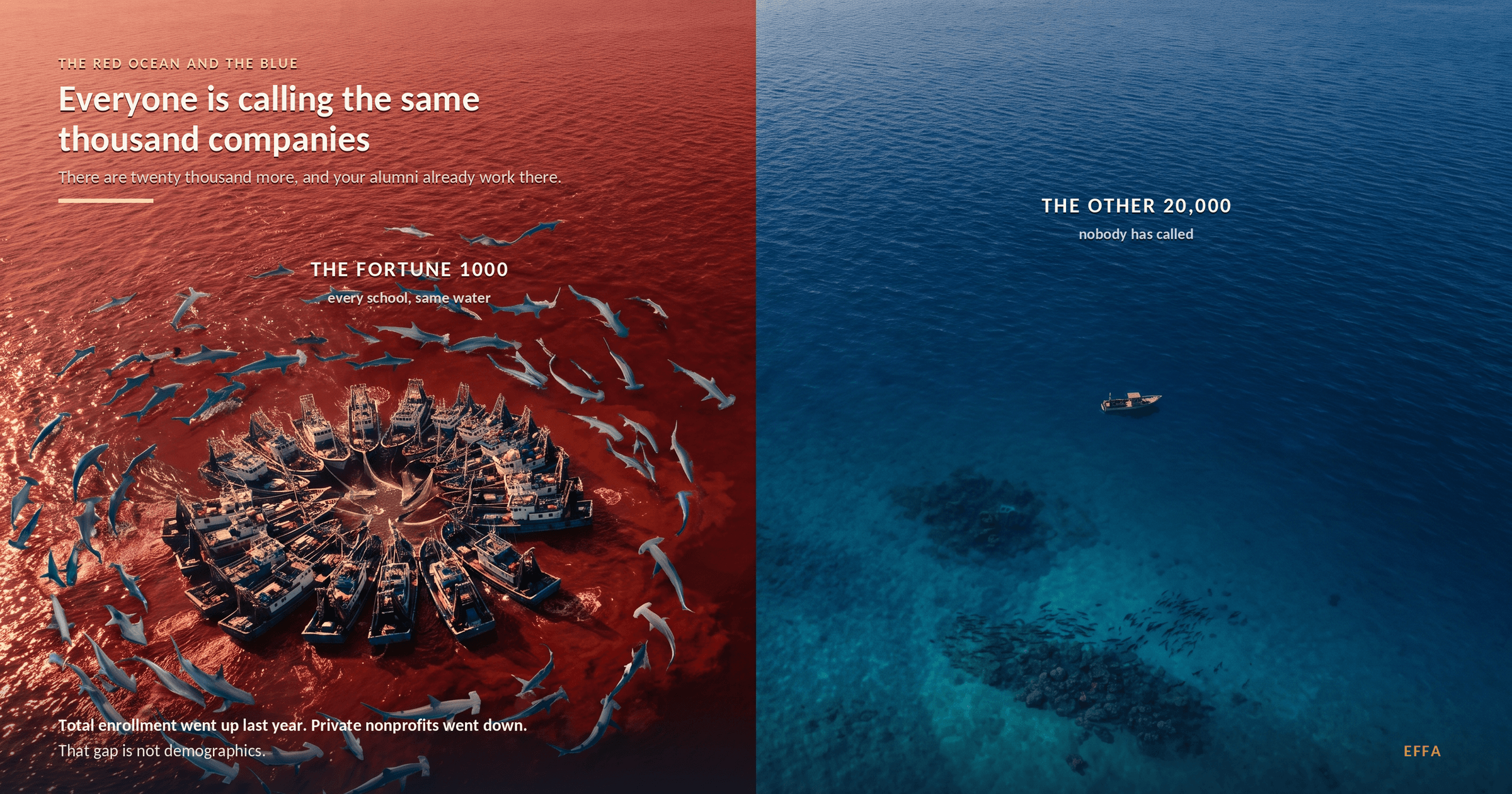
The employer channel did not fail. The target list was wrong. Everyone is fishing the same red ocean, and it was red before any of them got there.
The blue ocean
Strip out every employer in America with fewer than five hundred people and roughly twenty thousand firms remain. Large enough to have a real HR function, a benefits budget, and roles they cannot fill.
A thousand of those are the Fortune 1000.
Almost everything the sector calls an employer strategy is aimed at that thousand.
The other twenty thousand are hospital systems, manufacturers, insurers and regional banks, logistics operators, senior care networks, utilities, school districts, municipalities. Not glamorous, which is exactly why they are available.
And here is what I want to be careful about, because the easy version of this argument is wrong.
These employers are not strangers. A school does not arrive there cold. Its alumni are already inside the building, sometimes running the department. Its graduates already fill those roles. Board members overlap. The employer's people already take courses there, one at a time, paying out of pocket, with nobody on either side treating it as a relationship.
The goodwill is already there. What is missing is a channel. That is a very different problem from breaking into a market, and a much better one to have.
It is also why the comparison to a national provider is not close. Proximity is worth nothing to a Fortune 100 procurement team and a great deal to an employer twenty minutes from campus. A shared alumnus is worth nothing in an enterprise RFP and is often the entire reason a first meeting happens. Every argument for why a regional school cannot beat a national vendor for a Fortune 100 contract is an argument for why it should win the employer down the road.
So why has this not already happened
Because the deal costs the same to do regardless of how big it is.
A custom partnership agreement takes six to nine months. Legal review on both sides. A negotiation over terms nobody has done before, because the last one was also bespoke. A billing arrangement invented from scratch. A cohort definition argued out by people who have other jobs.
That effort is arguably justified for an employer who might send two hundred people. It cannot be justified for one who will send eight.
So schools do the rational thing. They aim the effort at the giants, where the volume might repay it, and they lose. Or they do not aim it anywhere, and the goodwill sitting in those twenty thousand buildings stays exactly what it has always been, which is goodwill.
The barrier is not interest, and it is not access. It is that nothing is standardized. Every partnership is a bespoke project, so the second one costs what the first one cost, and the whole thing sits behind a wall built out of legal review and improvisation.
That is not a market problem. It is a process problem, and process problems have a particular quality. Solve the process once and the twentieth employer costs almost nothing, which is what makes the employer sending eight people worth having.
What this actually asks of a school
Not a campaign, and not a pivot.
It asks which industries the school has a genuine right to win in, which employers inside a commuting radius match its strongest programs, and who in those buildings already has a connection to it. That is a different exercise from studying a market, and most schools have never done it deliberately.
It asks the school to get past the four things that stall employer partnerships before anyone reaches the question of terms.
And it asks for patience that a purchased lead never required, which is the honest reason this is hard. A lead arrives today. An employer relationship takes a quarter to build and then produces students for years, which is the same reason it is worth having when the other channel gets expensive.
Total enrollment went up last year. Private nonprofits went down. That gap is not demographics and it is not AI. It is whether a school had more than one way to reach a student.
There are twenty thousand employers in this country large enough to matter, and your alumni already work at most of them.
Somebody is going to call them.