Why Schools Struggle to Recruit Employer-Funded Students
August 31st, 2026
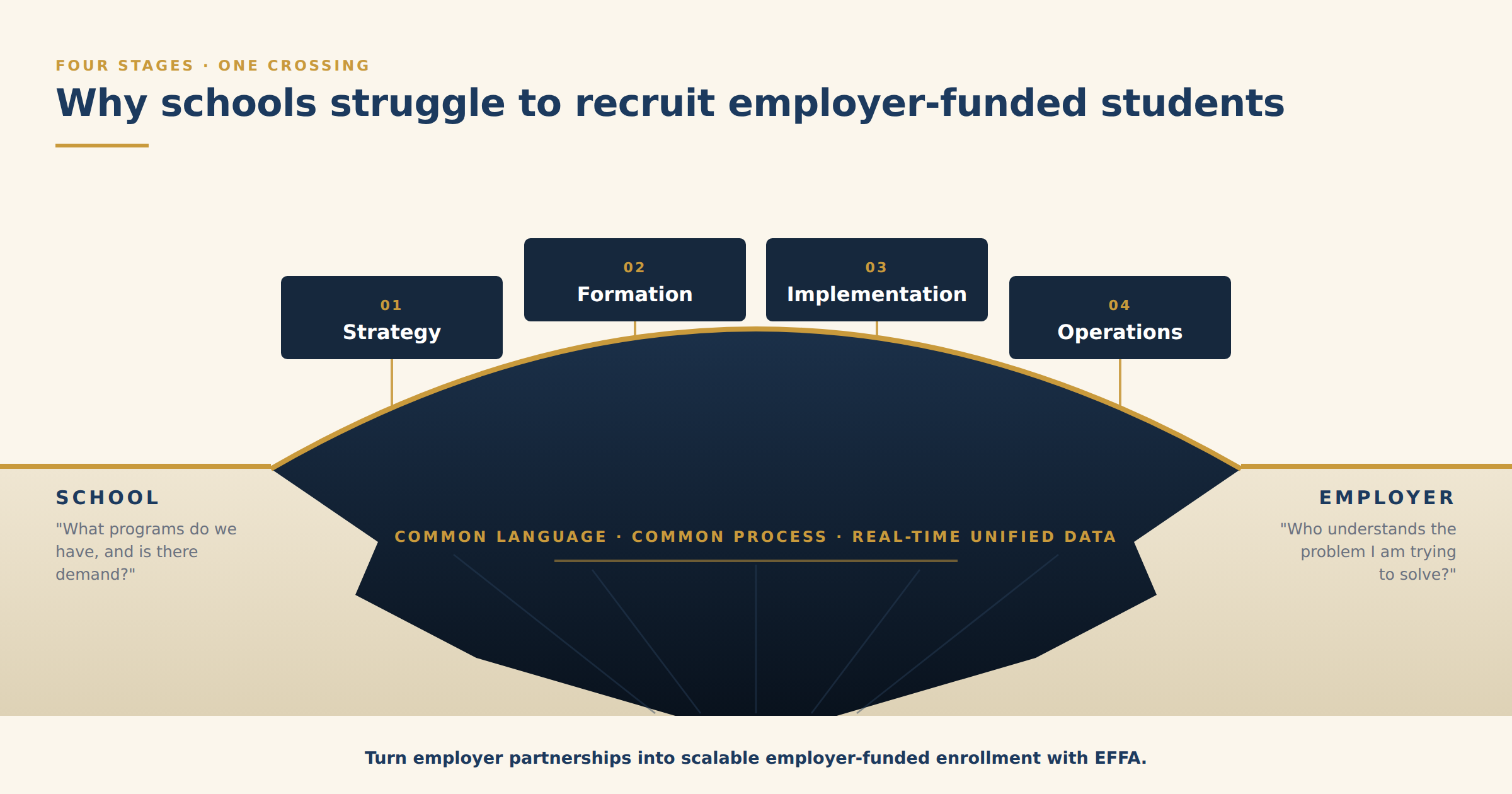
Every school I talk to says employer partnerships are a priority. Then I look at where the money goes.
I have watched institutions spend two to five thousand dollars per enrollment on paid marketing, and hand as much as eighty percent of tuition revenue to an online program manager, while investing close to nothing in the employer channel. Public contract reviews put the intermediary take at twenty-three to fifty percent. In the deals I have seen, it goes considerably higher.
I know for a fact it is not hypocrisy. It is that very few schools have seen results with employer-funded enrollment. So the money goes where the results have been.
Which raises the real question. Why haven't they?
Schools do not know employers.
Not in the sense of lacking contacts. In the sense of never having sat on the other side of the table. And it shows up at every one of the four stages where this work either scales or dies.
Barrier 1 · Strategy
A school planning employer growth asks: what programs do we have, and is there demand for them?
The employer is asking a different question entirely: who understands the problem I am trying to solve with my own workforce?
Those are not the same conversation, and the first one does not lead to the second. This is the difference between a market view and market access, and it is the subject of the previous piece.
Without a targeted strategy the effort scatters. Everyone is busy. Nothing compounds.
Barrier 2 · Partnership formation
Most institutions take six to twelve months to formalize a single employer partnership. Commercial terms, policy review, legal, compliance, coordination across teams that have never had to coordinate on this before.
Three things are usually wrong before the first meeting.
No clear stakeholder ICP, meaning ideal customer profile. Nobody has separated the decision-maker from the user. At most employers the decision sits with a VP of Total Rewards or Benefits, sometimes the CHRO, and budget authority may sit in finance. The person who has to actually run it is the benefits administrator or the learning and development lead. The person who feels the shortage is a frontline manager who is never in the room. Three different people, three different incentives, and a pitch aimed at none of them lands with none of them.
No value proposition for the employer. Schools lead with what they need. Enrollment, seats, a signed agreement. The employer is waiting to hear what is in it for them.
Stalled pipelines. Most deals die in "we should do something together" limbo, which is not a rejection and therefore never gets cleaned out of the pipeline.
By the time an agreement is signed, the champion has often moved on and the budget has shifted. And even when it is signed on time:
Congratulations. But you are not at first base. You are in the dugout.
Barrier 3 · Implementation
This is the one that kills it, and it is the one nobody names.
An executed agreement is a document. Turning it into enrollment requires two organizations that share no language, no workflow and no incentives to start doing something new together, every term, by hand.
School: wants to enroll adult learners and reach tuition benefit dollars. Employer: gets little out of it directly, and is still asking what is in it for them.
School: has nobody dedicated to employer relationship management. Employer: has no dedicated resource to manage a school relationship.
School: struggles with billing, eligibility and reconciliation. Employer: runs different systems, different language, different incentives.
School: has no boots on the ground to activate and cultivate interest. Employer: different roles, different access, nobody obviously in charge.
Read those two lists again. Neither side is doing anything wrong. Both are behaving rationally given their staffing and their priorities. The partnership simply has no owner on either side, and work with no owner does not happen.
So after formalization the relationship gets shelved, because operationalizing it requires manual work nobody is staffed to do. That is how a signed deal becomes a piece of paper collecting dust in a drawer at the employer.
Barrier 4 · Day-to-day operations
For the few partnerships that do activate, the process breaks where it matters most. Three parties, three separate failures, one shared outcome.
The student is asked to pay upfront, then chase reimbursement. Confusing processes that discourage participation. No single place to see eligibility or payment status.
The school runs manual eligibility checks, spreadsheets and email chains, across fragmented one-off deals in different divisions. No way to see which partnerships actually drive enrollment.
The employer has zero real-time visibility into benefit usage, inconsistent policies across university partners, and no way to prove return.
That last line is where the loop closes. An employer who cannot prove the return does not defend the budget. The operational failure this year is what removes the money next year.
What separates the schools that scale
I have watched institutions on both sides of this. The pattern is consistent enough that I would call it a rule.
Scaled: started with three to five programs with clear employer appeal. Stalled: treated B2B as an add-on to existing enrollment marketing.
Scaled: clear on the employer ICP, not just chasing national brands. Stalled: chased large national brands with long procurement cycles.
Scaled: invested in a dedicated B2B owner with authority. Stalled: no single owner, so partnerships fell between departments.
Scaled: standardized commercial terms before outreach. Stalled: custom-negotiated every single deal from scratch.
Scaled: measured partnership-driven enrollments, not MOUs signed. Stalled: confused market access with market view.
The last item on the stalled side explains most of the others.
But the most common failure is more basic than any of that, and it happens before the strategy is ever tested.
The wrong person is leading the effort. B2B gets handed to someone whose actual job is something else, usually inside enrollment marketing, and they are asked to build a commercial channel in the margins of a role they already have.
And hiring the right leader does not clear the path either. I have watched strong B2B leaders arrive and still stall out. It is almost never the org chart. You do not need to reconfigure a school to accommodate this work. What you run into is that the people whose sign-off you need have never done this before, so they cannot tell a reasonable request from an unreasonable one. Registrar, bursar, financial aid, legal, IT. None of them are being obstructive. They are being careful about something they do not understand, and from the outside, careful is indistinguishable from blocked.
That is the part I would say to any president. Leaders who do not understand this work become blockers instead of enablers, and they do it while believing they are protecting the institution.
The shift
Every barrier in this piece is the same mistake wearing different clothes. At each stage the school reasons from its own side of the table, and at each stage the employer quietly disengages, usually without ever saying so.
Which points at the change that has to come first, before any process or platform.
Stop treating employer partnerships as a marketing campaign. Start treating them as an enrollment operations channel.
A campaign has a budget, a season and an end. A channel has an owner, a standard, a workflow and a number somebody is accountable for. Employer-funded enrollment has only ever worked as the second thing.
We built EFFA starting from the employer's requirements because employers are buyers of talent and skills. And buyers do not learn a new language for every seller. They need one language, one process, and one real-time view of what they are paying for, so a partnership can survive the people who made it.
So that schools can get back to doing what they do best. Training and preparing the engine of the US economy, our workforce.
Read the previous piece: Market View vs. Market Access