Market View vs. Market Access: What Schools Need to Develop Employer Partnerships
August 28th, 2026
In our work with a large provider, we got into a conversation about how schools grow employer-funded enrollment. They shared a beautifully produced market report on one of their programs, prepared by a highly respected national consulting firm.
The employer side of the market was squarely in scope. The report set out to assess demand for the program and what the institution should do about it, and a large part of it is given over to exactly that: which employers are hiring, for which roles, with which skills, in which industries. This was not a study of something else that I am holding to the wrong standard.
I want to be fair about it, because it was good. Properly researched, clearly written, handsomely made. It showed that employer demand for the credential had grown faster than demand for bachelor's-level roles generally. It counted the job postings, over a million of them in twelve months. It ranked the top job titles, the skills employers ask for most, the leading industries, the busiest cities, the employers posting the most roles. It charted degree completions against the number of institutions producing them and concluded that student demand was outpacing competition.
Anyone in senior leadership would be glad to have it.
Then it made its recommendations. Move the calls to action higher on the program page. Add a chatbot, a course demo, a tuition calculator. Offer more start dates. Have admissions staff ask prospective students about their professional goals. Send the follow-up email after the call.
Every one of those is an action for the academic and operations side of the house. Fix the webpage. Adjust the calendar. Coach the team. All sensible. All internal.
The report studied employers carefully and then recommended things to do to ourselves. None of it tells the school what to do tomorrow to win an employer.
What that report is, named accurately
It is a market view. A macro picture of a category, built to help leadership decide whether a program is worth investing in.
That is a real question, and for that question it is the right tool. This is not an argument that the work is bad. Nobody is doing a poor job. A market view is simply a different product from the one a school needs when the goal is employer partnerships.
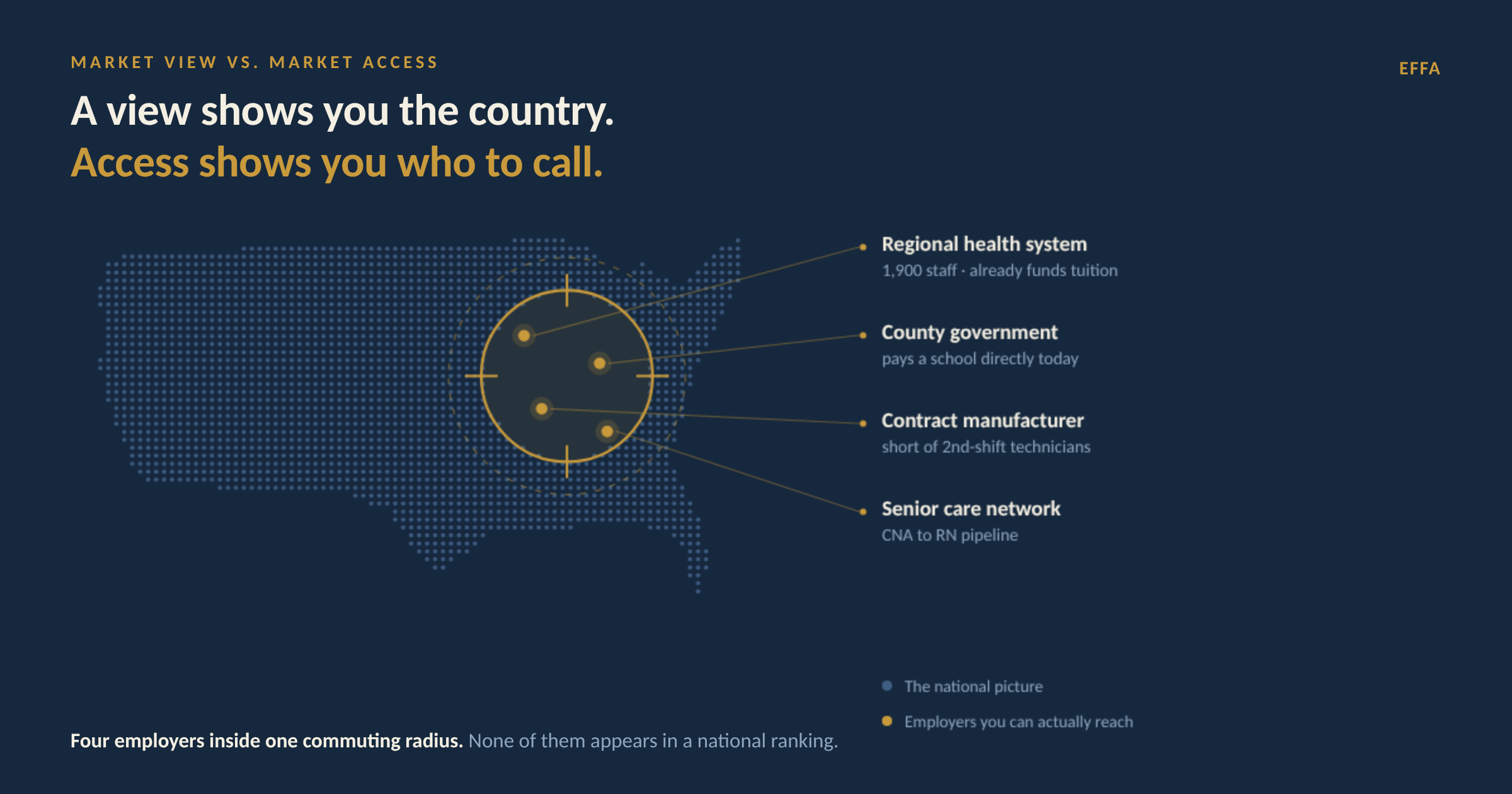
Because a market view produces guidance. Market access produces results — not a list of things to improve, but a list of people to call.
The four questions market access answers
A market view can answer none of these. They are what a school has to know before it can grow through employers, and they are why access is a different discipline rather than a better version of the same one.
Where do I have the right to win?
Not where demand is high. Where demand is high and within reach and underserved by whoever is already there. A right to win is local and specific. For most schools it is the three hospitals, the two manufacturers and the county system within a forty-minute drive — and it is usually a narrower list than anyone expects.
Who can I win over, and why me?
Which named employers, and the actual reason they should choose this institution over the three others in the region and the two national online providers already sitting in their benefits portal. "Why me" has to survive being said out loud to a benefits director.
What do they need from us?
Which programs, at what modality, at what price, with which start dates — mapped to the roles they cannot fill and the staff they cannot advance. This is the question that turns a program portfolio from an inventory into an offer.
How do we reach out?
Who to contact, what to say, what to send, and what to ask for in the first meeting. Not a strategy deck. A sequence somebody can run on Monday.
Answer those four and a school has a channel. Answer none of them and it has a very good report.
The remedy offered for a view problem is more view
There is one more thing worth noticing, and it is not a criticism of anyone.
When a report of this kind reaches its final page, the recommended next step is usually more research. Another scan, another feasibility study, another look at the portfolio.
The remedy offered for a view problem is more view. Not because anyone is cynical, but because that is what the category is built to produce — and because the alternative, going and getting the employer, is not a research product. It is a channel, and somebody has to build it.
I said as much to the firm that produced the report.
It is genuinely useful work, and it will not generate a single additional employer partnership tomorrow. If you are serious about employer-funded enrollment, at some point you have to stop assessing the market and go build the partnerships.
An access problem, not an information problem
None of this makes the view worthless. It is upstream of the decision, and upstream matters.
But a school does not have an information problem. It has an access problem in its own back yard. The employers are twenty miles away. Some of them have been paying for their people's education for years. Nobody at the school knows which ones, because there has never been a way to find out that did not involve knocking on doors one at a time and hoping the right person answered.
Building an employer-funded enrollment channel takes a clear strategy and the execution to operationalize the partnerships. That is why we built EFFA Advisory to help schools with market access, and the EFFA platform to formalize, transact and grow the partnerships that come out of it.