Why Schools Are Addicted to Web Leads
September 11th, 2026
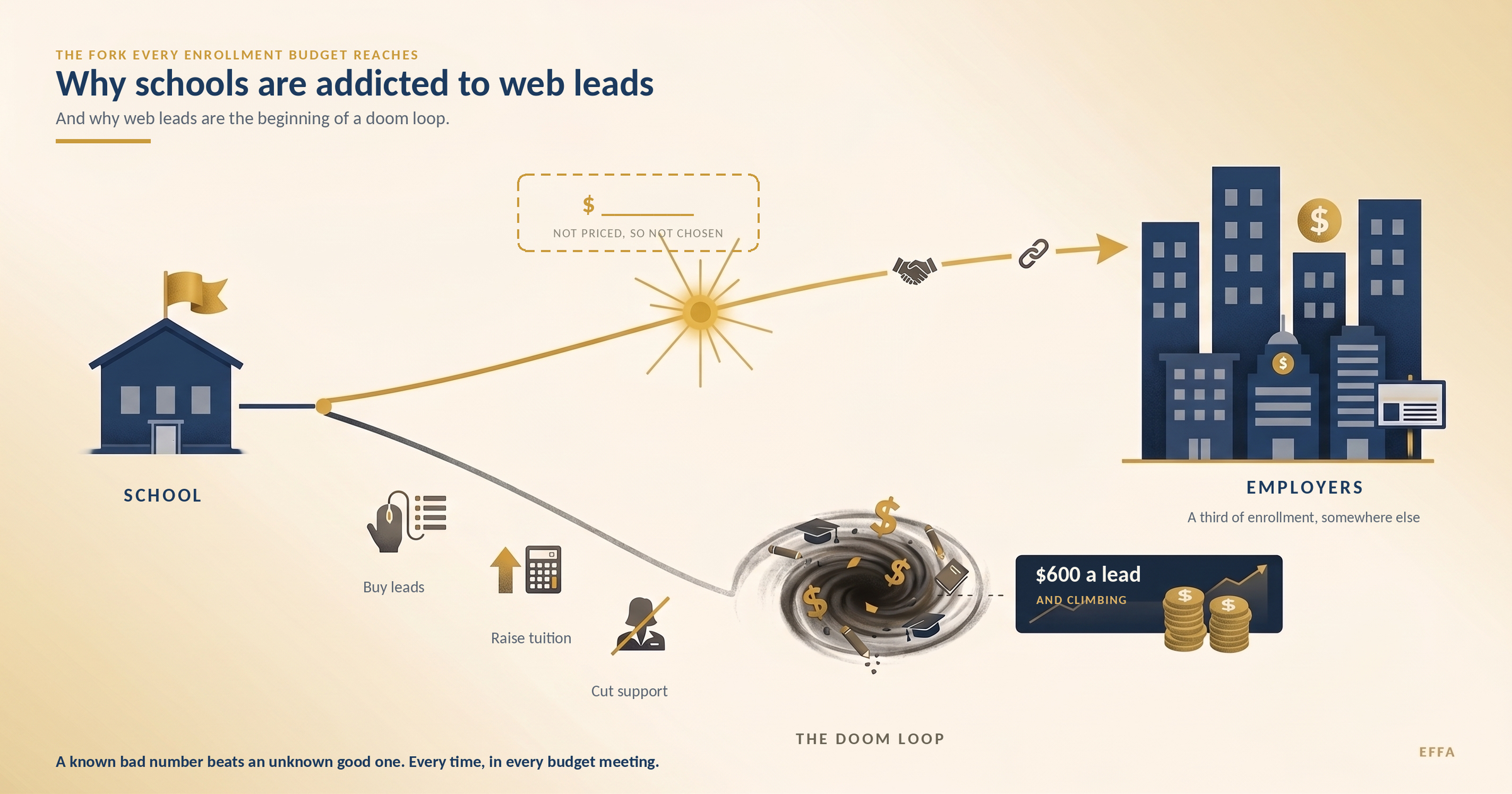
Every president I have talked to this year told me the same thing about their web leads. The flow is down somewhere between fifty and seventy percent, and they are scrambling to replace it.
Then each of them said the same second thing. Employer partnerships are obviously where enrollment should come from. We just do not know where to start.
Let us noodle with that gap, because the reason it persists is not the one people assume.
The easy path
Buying leads is easy in a specific and underrated way. You write a check for a number of leads at a known price and you hope a percentage of them convert. One line item. One invoice. One conversion assumption you can put in a model and defend in a budget meeting.
It is not easy because it works. It is easy because it is simple to transact.
And the price of that simplicity has been climbing for years. Published benchmarks put the cost of a single inquiry between one hundred twenty-eight and one hundred fifty-seven dollars depending on program level, and the cost of an actual enrolled student between fifteen hundred and thirty-eight hundred. Non-brand paid search costs rose roughly thirty-one percent in a year. Every school is bidding for the same people on the same platforms, so the bidding pushes the number up for everyone at once.
Those are the published figures. Here is one that is not published.
One of those presidents told me that a couple of the agencies he had turned to were producing leads north of six hundred dollars each.
Six hundred dollars for a lead. Not an enrollment. A lead. The industry benchmarks are not the ceiling in this market. They are closer to the floor.
Who pays for it
Nobody absorbs a cost curve like that quietly. It gets paid for, and it gets paid for in three places.
Tuition goes up. The acquisition line has to come from somewhere, and it comes from the price the student pays.
Supporting functions get cut. Advising, tutoring, career services. The functions that determine whether the student finishes and whether the degree pays off are the ones with the least protected budgets.
Retention gains get recycled. When a cohort happens to stay longer, the surplus does not go back into teaching. It funds more leads.
That last one is what makes it a loop rather than a line. The channel funds itself out of the very outcomes that were supposed to justify it.
And it is worth naming where the money originally came from. Tuition is paid substantially with borrowed money. Lead spend sits upstream of student debt. A six hundred dollar lead is not an abstraction on a marketing dashboard. It is a cost that eventually shows up in somebody's loan balance.
So why not the employer channel?
Here is the part that took me a while to see clearly, because the obvious explanation is wrong.
This framing is not originally mine. Bruce Douglas, former CEO of Education Dynamics, put it to me in a conversation and it reorganized how I think about the problem: schools can put a price on a web lead, and they cannot put a price on B2B.
It is not that schools have weighed the employer channel and rejected it. Everyone I speak to covets it. It is that they cannot put a number on it. They don't know how to.
Ask an enrollment leader what a paid inquiry costs and you get an answer in seconds. Ask what an employer-funded enrollment costs to acquire and the room goes quiet. Not because the number is bad. Because almost nobody has ever calculated it.
And they cannot calculate it because they do not know how to work with employers and cannot speak the language. That is the finding underneath the four barriers of the previous piece, and it has a direct financial consequence.
A known bad number beats an unknown good one. Every time, in every budget meeting.
This is the whole mechanism. A school is not choosing leads over employers. It is choosing the only option that has a price on it. You cannot choose a channel you cannot price.
Somebody has priced it
Four publicly traded institutions now disclose what happens when the employer channel is actually run rather than endorsed, and their numbers are in audited filings and statements to investors rather than in anybody's marketing deck.
Phoenix Education Partners, the parent of the University of Phoenix, reported employer relationships at approximately 32 percent of Average Total Degreed Enrollment in fiscal 2025. CEO Christopher Lynne put it near 36 percent by the quarter ending May 2026.
Perdoceo disclosed 38.3 percent of enrollment at Colorado Technical University coming through employer engagements in its most recent annual filing.
Strategic Education reported employer-affiliated students at 34.7 percent of US higher education enrollment in the second quarter of 2026, an all-time high, up from 31.8 percent a year earlier.
Grand Canyon Education put it at over 32 percent of GCU students, per Chairman and CEO Brian Mueller in July 2026.
Four institutions. Roughly a third of enrollment each. I wrote about this in more detail earlier in the year.
But two things those executives said matter more here than the percentages.
Brian Mueller, describing how Grand Canyon generates those starts, told investors the process "has nothing to do with generating leads."
And Karl McDonnell, CEO of Strategic Education, described the employer channel to his own investors as "a completely proprietary channel of new students for us. There's almost no acquisition cost for those."
Read those next to a six hundred dollar lead.
I want to be careful here, because these are two sentences from earnings calls rather than a disclosed cost model. Neither company published its actual acquisition cost. What they published is a judgment, made by people who run this at scale and who answer to shareholders for it. That is not proof of a number. It is proof that the number is knowable, and that somebody knows it.
There is one more thing I will state from my own experience rather than from a filing. Employer-funded students retain better. I have been inside several of these institutions and I have watched it hold across all of them. A student whose employer is paying, whose manager knows they are enrolled, and who is studying something their job actually needs behaves differently from a student who found you through an ad. I have not seen a public dataset that proves it, so take it as what it is. Twenty-five years of watching the same pattern.
So what does it take to break the habit?
Anyone who has watched somebody get sober knows the sequence, and it does not start with a plan.
It starts with admitting, out loud and in front of other people, that there is a problem.
We have a lack of employer-funded enrollment problem.
Not a marketing problem. Not a lead quality problem. Not a brand problem. Those are the diagnoses that let everyone keep doing what they are already doing.
The honest version is longer and worse. We are spending more every year to buy the same students. We are funding it out of tuition and out of the functions that help students finish. And the channel that four public companies have now proved produces a third of their enrollment is the one we have never built the capability to run.
Saying that out loud in a cabinet meeting is harder than any spreadsheet exercise that follows it, and nothing follows it until somebody does.
The second step is learning what the problem actually is, specifically. Not we should do more with employers, which is a sentiment. Which employers, in which industries, within which radius, hiring for which roles, and what it costs to reach them and enroll one of their people. That is the difference between a market view and market access, which is the subject of the first piece in this series.
The third step is where most schools stall, and it is the one nobody sells them. Knowing what to do and being able to do it are different problems.
What we built
We built EFFA to help schools plan, budget, and execute every phase of that journey at a fraction of what they are paying now, so employer-funded enrollment becomes predictable, scalable, and cost-effective rather than a set of relationships that live in one person's inbox.
Predictable, because the same process runs every time. Scalable, because adding the next employer does not mean negotiating from scratch. Cost-effective, because the money you are not spending on a six hundred dollar lead is money that can go back where it belongs.
Into curriculum. Into teaching. Into keeping tuition low enough that fewer students have to borrow to become employable.