Four Million Employees. Four Thousand Students.
August 20th, 2026
Over the last few months I've had almost the same conversation with three different university presidents.
Each of them told me their web lead flow had fallen somewhere between 50 and 70 percent. Each was scrambling to replace it. And each said some version of the same thing about employer partnerships: yes, obviously, that's where enrollment should come from — we just don't know where to start. One had made a small investment and wasn't seeing much.
I want to take that conversation seriously, because there is now real public evidence about what happens when a school actually runs the employer channel rather than simply endorsing it. Four publicly traded universities disclose it. What they report is more interesting than either the optimists or the skeptics would like.
First, the channel is real, and it is not small.
Phoenix Education Partners — University of Phoenix's parent, which listed on the New York Stock Exchange last September — states in its annual report that "enrollment through our employer relationships represented approximately 32% of our Average Total Degreed Enrollment in fiscal year 2025." By the quarter ending in May 2026, CEO Christopher Lynne put that figure at roughly 36%.
Perdoceo's most recent annual filing discloses 38.3% of enrollment at Colorado Technical University coming through employer engagements.
Strategic Education reported employer-affiliated students at 34.7% of its US higher education enrollment in the second quarter of 2026 — an all-time high, up from 31.8% a year earlier.
And Brian Mueller, Chairman and CEO of Grand Canyon Education, told investors in July that "over 32% of GCU students are generated through this activity," adding that the way they get those starts "has nothing to do with generating leads."
Four institutions. Roughly a third of enrollment each. These are not projections or pilot programs — they are audited filings and statements to investors, which carry consequences if they're wrong.
So when a president tells me they don't know where to start with employer partnerships, they are describing a gap between their institution and a channel that is already producing a third of enrollment somewhere else — including at institutions having a difficult year.
Now the part that should stop all of us.
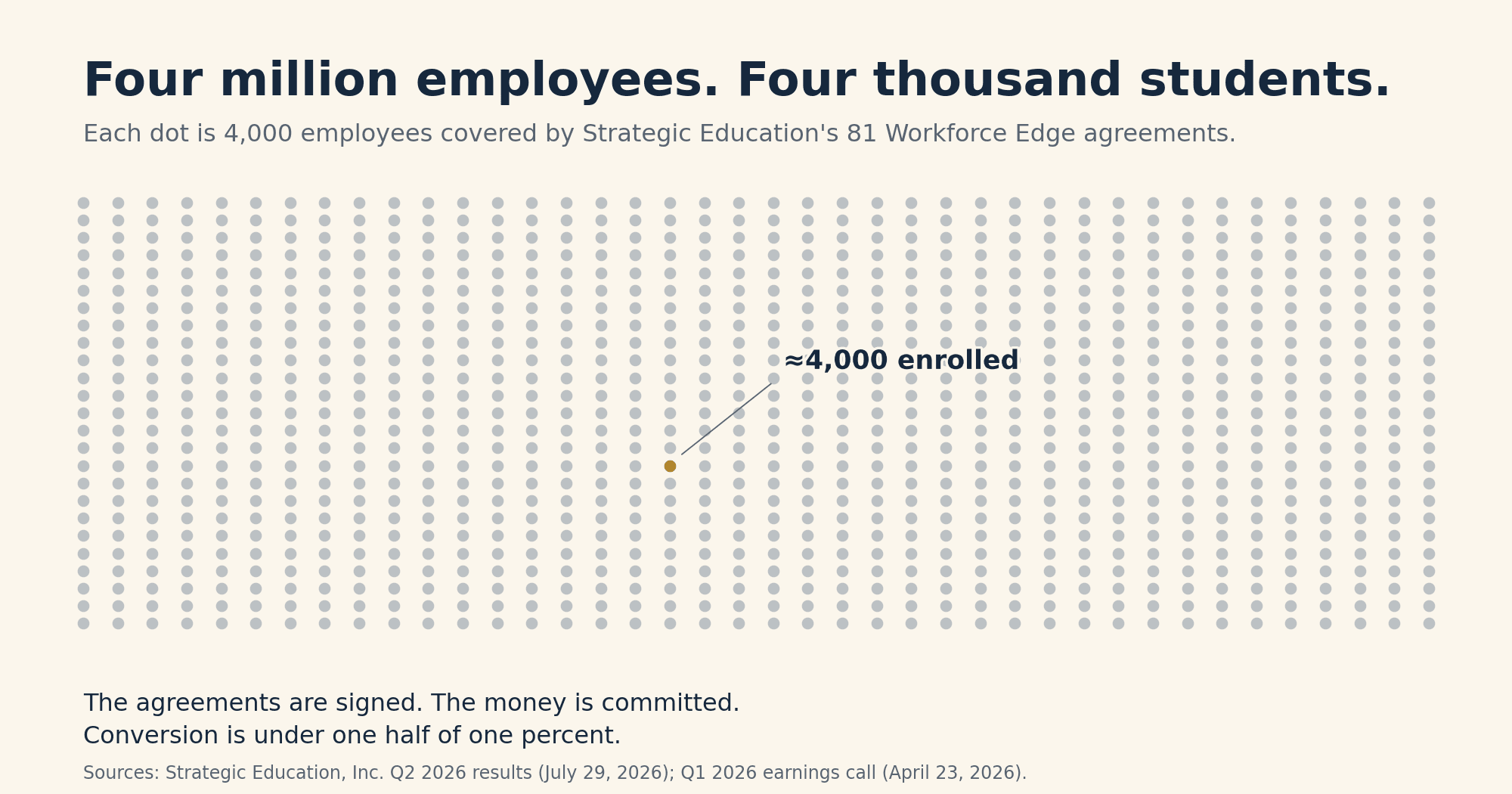
Strategic Education's Workforce Edge program has 81 corporate agreements covering approximately four million employees. In its first-quarter call this year, management said enrollments through that program had grown 70% and reached nearly four thousand students.
Four million people with access. Four thousand enrolled.
Even reading that as a single quarter rather than a running total — even multiplying it by four — the conversion stays under half a percent.
I don't think that number means the channel is weak. I think it means something more uncomfortable. Four million people work somewhere that has already signed the agreement, already committed the money, already cleared the legal review. And essentially none of them walk through the door.
Two more findings, because the honest version of this argument has to carry them.
Phoenix's CEO was asked directly about the economics of employer-channel students. His answer: they "tend to retain and complete at higher rates," but "the profitability has been very similar when we have done point-in-time measurements." That is the executive with the most to gain from claiming the channel is cheaper, declining to claim it.
And Strategic Education's employer share rose in a quarter when its total enrollment fell — 85,894 students, down from 86,339. Part of that 34.7% is a smaller denominator, not only a bigger numerator.
So: not free students, not a magic channel, and anyone selling it that way is skipping the filings.
But then there is the finding that I keep coming back to.
Inside Perdoceo, in the same year, under the same management: 38.3% employer-sourced enrollment at Colorado Technical University, and 7.5% at AIU System.
Same company. Same leadership. Same economy. A five-fold difference.
Whatever explains that gap, it is not the market. It is not employer willingness — the employers are the same employers. It is how the channel is operated: whether there is a team, a process, a shared language with the employer, and a path a working adult can actually complete.
That is the whole finding. The constraint on employer-funded enrollment is not demand and it is not money. It is plumbing.
Four million employees sit behind signed agreements. The money is committed. Section 127 has allowed this since 1978, and the $5,250 cap has been in place since 1986 — forty-one years, unindexed, until it finally adjusts for inflation starting in 2027. None of that is the bottleneck.
The bottleneck is that having a partnership is not the same as having a working path, and almost nobody has built the second thing.
Which brings me back to the three presidents.
They were right that employer partnership is where enrollment should come from. Where I'd push back is on where it sits in the institution.
B2B cannot be an afterthought, and it cannot be delegated to the career services office. It belongs at the top of the priority list, next to student success and job outcomes — because employers are the buyers of skill. They hire the talent. They hire the graduates. A relationship with an employer is not an alumni-services function or a placement function; it is an enrollment channel, a curriculum signal, and an outcomes engine at the same time.
Treat it as a side project and you get 7.5% — if you're lucky. Treat it as core and you get 38%.
The web leads are not coming back to where they were. That much the data supports: independent research from Pew found that when Google shows an AI summary, clicks on traditional search results fall from 15% of visits to 8%. Clickstream analysis puts the share of US searches ending without any click at 68%, up from 49% in 2019.
The channel that is replacing it already exists inside every school's employer relationships. It is just badly plumbed.
That is the problem I work on.
Sources
Phoenix Education Partners, Form 10-K, fiscal year ended August 31, 2025: https://www.sec.gov/Archives/edgar/data/1600222/000119312525289786/pxed_10k_2025.htm
Phoenix Education Partners, Q3 FY2026 earnings call, July 14, 2026: https://www.investing.com/news/transcripts/earnings-call-transcript-phoenix-education-partners-misses-q3-2026-eps-forecast-93CH-4791963
Perdoceo Education Corporation, Form 10-K, fiscal year 2025, filed February 19, 2026: https://www.stocktitan.net/sec-filings/PRDO/10-k-perdoceo-education-corp-files-annual-report-f8d112e0ad7d.html
Strategic Education, Inc., second quarter 2026 results, July 29, 2026: https://www.businesswire.com/news/home/20260729002131/en/Strategic-Education-Inc.-Reports-Second-Quarter-2026-Results
Strategic Education, Inc., Q1 2026 earnings call, April 23, 2026: https://www.investing.com/news/transcripts/earnings-call-transcript-strategic-education-q1-2026-results-reveal-mixed-performance-93CH-4633324
Grand Canyon Education, Q2 2026 earnings call, July 30, 2026: https://www.fool.com/earnings/call-transcripts/2026/07/30/grand-canyon-education-lope-q2-2026-earnings-call-transcript/
Pew Research Center, AI summaries and search clicks, July 22, 2025: https://www.pewresearch.org/short-reads/2025/07/22/google-users-are-less-likely-to-click-on-links-when-an-ai-summary-appears-in-the-results/
SparkToro and Similarweb, zero-click search analysis, June 9, 2026: https://sparktoro.com/blog/in-2026-less-than-one-third-of-google-searches-still-send-a-click/
Section 127 statutory history, 26 U.S.C. 127 amendment notes: https://uscode.house.gov/view.xhtml?req=granuleid:USC-prelim-title26-section127&num=0&edition=prelim