Ryan Craig Sounded the Alarm on Career Services. We Should Answer It.
September 28th, 2026
Ryan Craig of Achieve Partners, who has spent years arguing that the country needs apprenticeships more than it needs another degree, has come to a blunt conclusion about the college career center. Abolish it. Push the work into the curriculum, have faculty build real employer projects into courses, and stop pretending an office of four people with a job board is going to change anyone's outcome.
He is not saying it to be provocative. He is saying it because the evidence is bad.
Craig helped circulate a white paper by Geordie Brackin and Mike Goldstein that takes the career services office apart layer by layer, and it is difficult to read if you work in one. Michael Horn covered the same argument and reached a similar place.
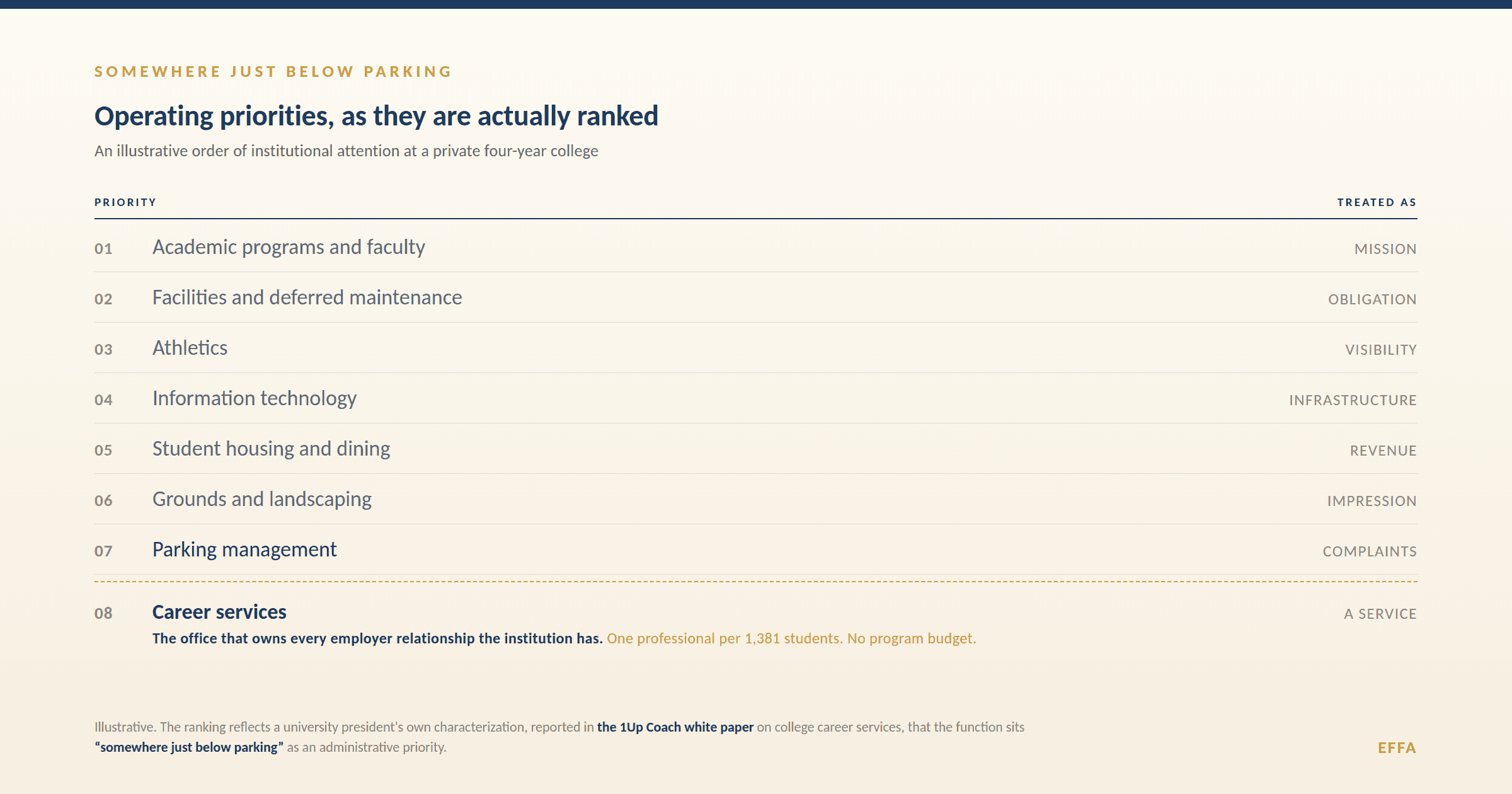
The line that should be on a wall somewhere: one university president told researchers that career services ranks somewhere just below parking as an administrative priority.
I believe the criticism is deserved, every word of it, and that it should be read as an alarm rather than an obituary. Somebody with no reason to flatter us has looked hard at this function and concluded it is not worth keeping. That is a call to action, and the people it is really about are the students on the receiving end.
Why the criticism lands
Look honestly at what a career services office offers most students in 2026.
Résumé review. A document formatting service for a document that is screened by software before a human sees it.
Interview coaching, typically thirty minutes, typically in the spring of senior year, typically after the roles that student wanted were filled in the fall.
And a job board. This is the part that should embarrass us. Most school career pages are a licensed platform pulling listings that exist elsewhere, aggregated and reposted under the institution's logo. The student reasonably infers that the school procured these roles, or that being from this school confers some advantage in applying to them. Neither is true. They are public postings, available to anyone, and the student is competing against everyone.
Brackin and Goldstein put numbers on what that produces. Roughly 27 percent of seniors secure a good job before graduation, and close to half of graduates end up underemployed. Students apply to fifty, a hundred, a hundred and fifty positions before anyone answers.
And the people staffing these offices, by and large, have never hired anyone. They have not sat on the other side of the table, never run a requisition, never rejected two hundred applications in an afternoon. That is not a character flaw. It is a hiring specification nobody wrote down.
The white paper also makes a point that deserves more attention than it gets. The students hurt most by all of this are the ones with the least social capital. A student whose parents can make a phone call never needed the career center. A first-generation student has nothing else, and the thing they are given is a résumé template and a login.
So yes. The criticism is fair.
What the alarm is actually telling us
You cannot indict a function for failing at a job it was never resourced, staffed, or led to do.
The median career center runs on a budget around half a million dollars a year, of which roughly 87 percent is personnel. There is essentially no program money. No budget to build employer relationships, no budget to place people, no budget to do anything other than pay the people who are already there to keep doing what they are already doing.
One professional for roughly every 1,381 students. At that ratio you are not building anything. You are triaging.
And only about a third of career centers run an employer partnership program at all.
Yes, budgets have risen recently. They rose off a floor. An office that ranks below parking and then gets a raise still ranks below parking. Growth from negligible is not investment.
So when someone says the career center does not work, the accurate response is: of course it does not. It was given a job board, four and a half people, no program budget, no employer mandate, and a reporting line into student affairs, and then asked to solve the single hardest problem the institution has.
Closing it would end the embarrassment without helping a single student. The failure is real. The cause is starvation, and starvation has a different remedy.
What the office should actually be
I believe career services belongs among the top three investments a school makes, alongside academic quality and the enrollment engine itself, and that it should be unrecognizable from what it is today.
It should be led by someone who has done business-to-business work. Not a student affairs administrator who inherited the portfolio. Someone who has carried a number, built a book of accounts, kept a commercial relationship alive across turnover on both sides, and knows what it costs to lose one. The skill this office needs is not counseling. It is account management.
Its mission should be outcomes, not services. Jobs. Internships. Apprenticeships. Employer-funded seats. Things that happen in the world, not activities that happen on campus and get counted.
And it should own the employer relationship on behalf of the whole institution. Not as a supplier of job postings for the spring fair, but as the front door through which local and regional employers meet the school, hire from it, send their people back into it, and fund those people's tuition.
Measured accordingly. Not on workshop attendance or satisfaction scores. On placements, on partnerships signed, on employer-funded enrollments, on whether the employer came back the following year.
The part nobody is saying out loud
There is a strategic argument here that goes well beyond student services, and I believe it is the most important thing in this piece.
A regional school cannot outspend a national one. It will not win a bidding war for attention, it will not out-market an institution with a national brand and a nine-figure budget, and every year it tries, it loses ground.
But a national school cannot replicate a relationship with the hospital system eleven miles from your campus. It cannot know which three roles that employer has been unable to fill for two years. It cannot call the vice president of human resources who graduated from your program in 2009. It has no alumni on that floor.
That is a moat. It is local, it compounds, it cannot be bought at auction, and it gets stronger every year it is tended.
It is also sitting, right now, in an office that ranks below parking.
The schools that figure this out in the next five years will not be the ones that spent the most on advertising. They will be the ones that looked at the least-respected office on campus and recognized it as the only defensible position they had.
Why this is the work we chose
For decades, the handoff between what schools teach and what employers need has been manual, slow, and fragmented.
EFFA exists to close that gap, giving schools and employers a common language, process, and data to work as one system, so learning leads to opportunity.
That is not a technology argument. It is the reason an office with four and a half people and no program budget has never been able to do this work, and the reason it becomes possible when the process stops being invented from scratch every single time.
Ryan Craig is right that the career center, as it exists today, is not going to close that gap. Nobody who has looked at it honestly could argue otherwise.
I take his call as the wake-up call it is. The students moving through these institutions right now cannot wait while we decide whether to feel criticized.
They need us to build the thing that should have been there all along.