What does it actually take for an employer to pay a school directly?
August 26th, 2026
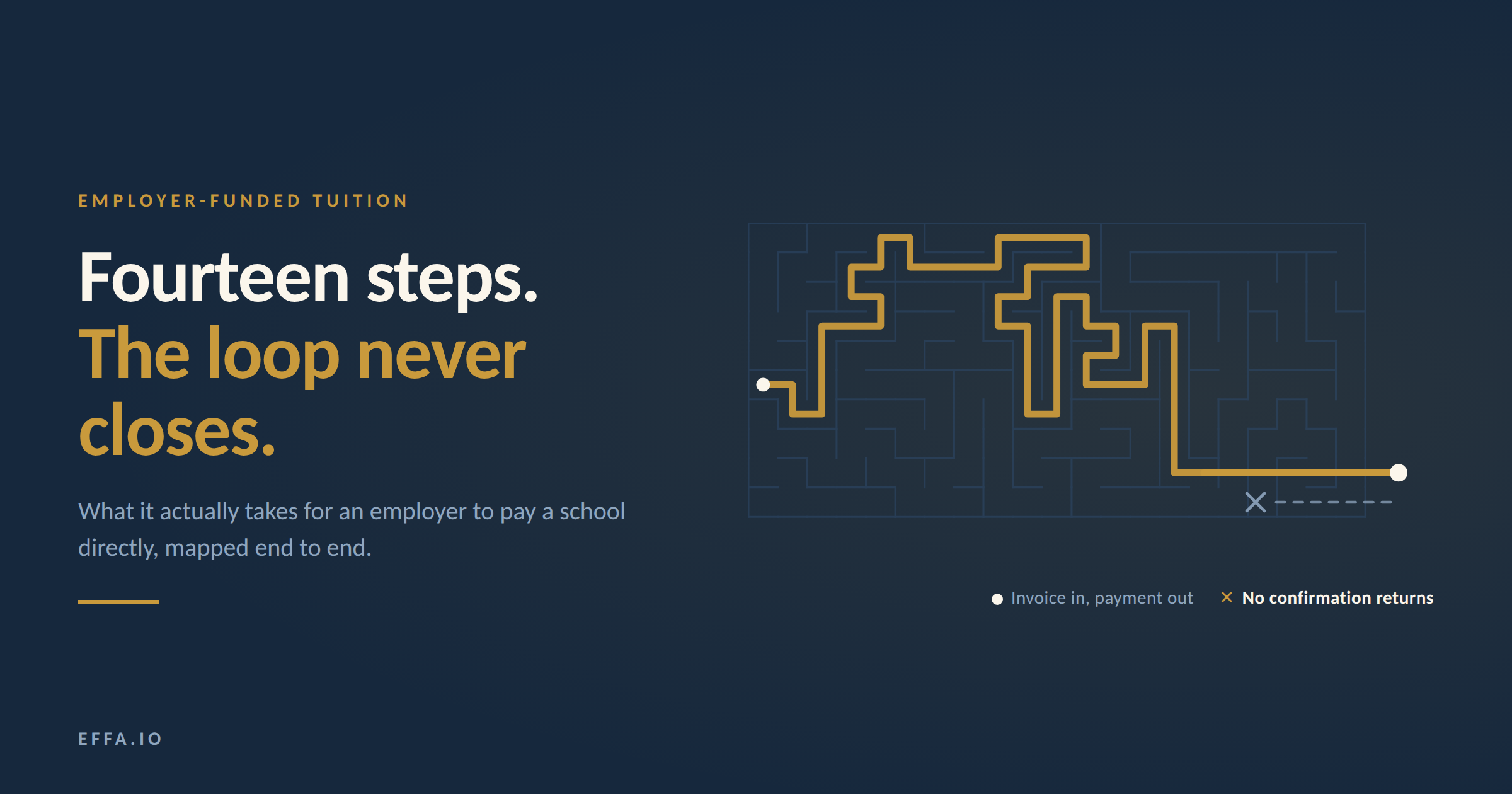
Most employers who offer tuition assistance reimburse. The employee pays the school, files a claim, and waits to be paid back. A smaller number pay the school directly, so the employee never fronts the money at all.
Direct payment is better for the employee. It is also considerably more work for the employer, and almost nobody has written down what that work actually is.
This guide does. The process below was mapped from a recorded conversation with a large regional employer that pays tuition directly today. It is one organization's process, not an industry standard, but the shape of it will be familiar to anyone who has tried this.
What does it mean to pay a school directly instead of reimbursing?
Direct payment means the employer pays the school and the employee never fronts the money. Reimbursement means the employee pays first, files a claim, and waits.
That difference sounds administrative. It is not. Reimbursement asks an employee to produce several thousand dollars up front and wait weeks or months to get it back. For a large share of the workforce that requirement is the whole barrier, and a benefit that only works for people who already have savings is not the benefit the company thinks it is offering.
Direct payment removes that barrier. It moves the cost, the paperwork and the waiting onto the employer and the school.
How many steps does it take to pay one tuition invoice today?
Fourteen. In the employer we mapped, this is the sequence for a single employee, for a single term:
The employee applies through an online form that sits outside any benefits system
The employee calls a financial counselor at the school
The school calls the employer to ask whether the person is eligible
The benefits administrator checks eligibility documentation by hand
A list is emailed to HR for approval
HR emails approval back
The administrator notifies the school that the employee is approved
The school sends an invoice to the administrator
The administrator writes a check request manually
The administrator tracks it on spreadsheets
The request routes to accounts payable for e-signature
Accounts payable processes it on its own schedule
No notification returns to the administrator confirming payment
The school chases the unpaid invoice
Read step 13 again. That is where most of the downstream pain originates. The person who started the process never learns it finished.
Who inside the company has to touch it?
Four functions, minimum:
The benefits administrator, who owns the process end to end and has the least authority over any single step of it
HR, which holds approval
Accounts payable, which holds the money and its own schedule
Whoever owns the eligibility record, which is often a different system and sometimes a different person
Add the school's financial counselor and student accounts team, and a single tuition payment involves six people across two organizations who do not share a system.
Why does it take that many steps?
Because every step was added by someone competent solving a real problem.
Eligibility verification exists because tuition assistance has rules and somebody has to confirm the employee meets them. The approval chain exists because spending authority is delegated and audited. The manual check request exists because accounts payable needs documentation it can defend. The spreadsheet exists because nothing else tracks this. The e-signature routing exists because someone once approved something they should not have.
Nobody designed this sequence. It accreted, one reasonable addition at a time, and each addition was correct in isolation. That is why it is hard to remove any single step by arguing that it is unnecessary. Individually, none of them are.
The problem is not any one step. It is that fourteen of them run in series, by hand, with no shared record.
Where does it break first?
Three places, and they are the same three every time:
Eligibility verification. The school does not know who is eligible, so it calls the employer. The employer checks by hand. Both sides are maintaining a version of the same fact and neither can see the other's.
The approval chain. Approval lives in email. Email has no state. Nobody can answer "where is this right now" without asking someone.
Accounts payable. AP runs on its own cycle and reports to nobody in this process. The invoice enters a system that has no obligation to tell anyone when it comes out.
Everything else is friction. These three are failure.
What happens when you add a second school?
The fourteen steps repeat per employee. The relationship setup repeats per school.
That second part is the one that surprises people. Each new school partner means a new conversation about invoicing format, a new contact for eligibility questions, a new payment path, and often a new agreement. The per-employee cost was always going to scale linearly. The per-school cost is what turns a manageable benefit into somebody's full-time job.
Most employers discover this at their second or third school partner. Very few get to their tenth.
This is why manual direct bill stops scaling. Not because direct payment is the wrong model, but because doing it by hand costs more every time you succeed at it.
Is reimbursement the right way to administer this?
Three questions worth asking, and the answers are not close.
Does it serve the employee? No. Reimbursement asks the person the benefit exists for to produce several thousand dollars and then wait. The employees who most need help paying for school are the least able to front the cost, which means the benefit is least available to exactly the people it was designed for.
Is this how we administer any other benefit? No. Nobody pays their doctor or their dentist in full and then files a claim to get the money back. Health coverage is administered by paying the provider directly, because the industry accepted long ago that a benefit requiring the employee to float the cost is not really a benefit. Tuition is the one place we still do it the other way, and there is no principled reason for it.
Is tuition a cost or an investment? It can and should be treated as an investment, and it is one of the few benefits where the return is genuinely measurable. Completion. Retention. Internal promotion and fill rate. Time to proficiency in the role you were trying to staff.
But notice what reimbursement does to that. Administered as a claim, it produces claims data: who filed, and for how much. It does not tell you who completed, who stayed, or who moved into the job you were trying to fill.
You cannot measure the return on an investment you have structured as an expense reimbursement.
What would have to change?
Three things, and they are the same three whether you have one school partner or twenty.
A common language. Steps 2 through 7 exist because the school and the employer describe the same student, the same eligibility rule and the same program in different terms, and somebody has to translate by hand every time.
A common process. Approval, invoicing and payment currently follow whatever path each relationship happened to establish. Standard terms and one agreed route take the negotiation out of every new partnership.
One shared record, in real time. Step 13 is an absence. Both sides are waiting for the other to say something, and neither can see the state of the thing they are both working on.
None of these require the employer to change what it funds, who is eligible, or how much it spends. They change how the work moves, not what the work is.
Where EFFA fits
EFFA is the neutral infrastructure that connects employers and schools so tuition can be paid directly without either side building this process by hand. Employers use it at no cost; schools pay 3.5% standard. That is the whole commercial model.