Nobody Should Have to Borrow to Become Employable
August 20th, 2026
Two things are true right now, and they point in opposite directions.
Americans trust higher education less than they have in a generation. And American employers need people retrained more than they ever have.
Both. At the same time.
I have been in this business long enough to have watched both of those become true, and I still find the combination hard to sit with. We have never needed learning more, and we have never trusted it less.
Look at what is happening at once.
AI is forcing companies to rethink how they hire and how they develop the people they already have. Stanford's payroll panel finds employment for 22-to-25-year-olds in the most AI-exposed occupations running about 19% below where it would be had it kept pace with same-age workers in less-exposed occupations — though the authors are careful to call that descriptive rather than causal, and serious researchers at Yale and the Economic Innovation Group argue the real cause is the interest-rate cycle, not the models.Schools are under genuine financial pressure. The share of private colleges running negative earnings margins — before taxes, depreciation and amortization — went from 7.2% in 2024 to an estimated 12.2% in 2025, and Moody's forecasts 16% this year.
Schools are under genuine financial pressure. Moody's projects the share of private colleges running negative operating margins moving from 7.2% to 12.2% to 16% in the space of two years.
Students are questioning the premise itself. Thirty-nine percent of high schoolers say AI is pushing them to consider alternatives to college. Undergraduate certificate enrollment is up 10.2% — the fastest-growing credential in the country — while private nonprofit four-year enrollment was essentially flat.
And the trades are absorbing people who a decade ago would have defaulted to a degree without thinking about it.
Those are not four trends. They are one thing happening from four directions. The workforce is not adjusting. It is being reimagined — and somebody is going to decide what it gets reimagined into.
Everyone is arguing about what people should learn, how fast they should learn it, and whether the job survives.
Almost nobody is asking the next question.
Who pays for the retraining?
Right now the answer defaults to the worker. They pay for it, they find the time for it around a job, and they hope it works out.
Employers are spending less on it, not more. Average training spend fell from $1,254 per employee to $846 in a single year — down a third — while the formal learning hours employees actually logged went up.
The federal government's flagship workforce statute moves about $3.2 billion a year into a system that spends $1.1 trillion.
And the bill lands where it always lands. Americans hold $1.65 trillion in student debt. Earlier this year more than one dollar in ten of it was ninety days or more past due — and in a single quarter, 2.6 million borrowers who had fallen more than four months behind were handed to the Education Department's Default Resolution Group.
Total student loan balance, Q2 2026 — Federal Reserve Bank of New York, August 11, 2026: https://www.newyorkfed.org/newsevents/news/research/2026/20260811
Here is what makes that hard to accept.
Employers are already the largest trainer in America, and it is not close. The last time Georgetown's Center on Education and the Workforce measured the whole system, it came to roughly $1.1 trillion a year. Colleges and universities accounted for about $407 billion. Employers accounted for about $590 billion — $177 billion of that formal training, the rest the learning that happens inside the work itself.
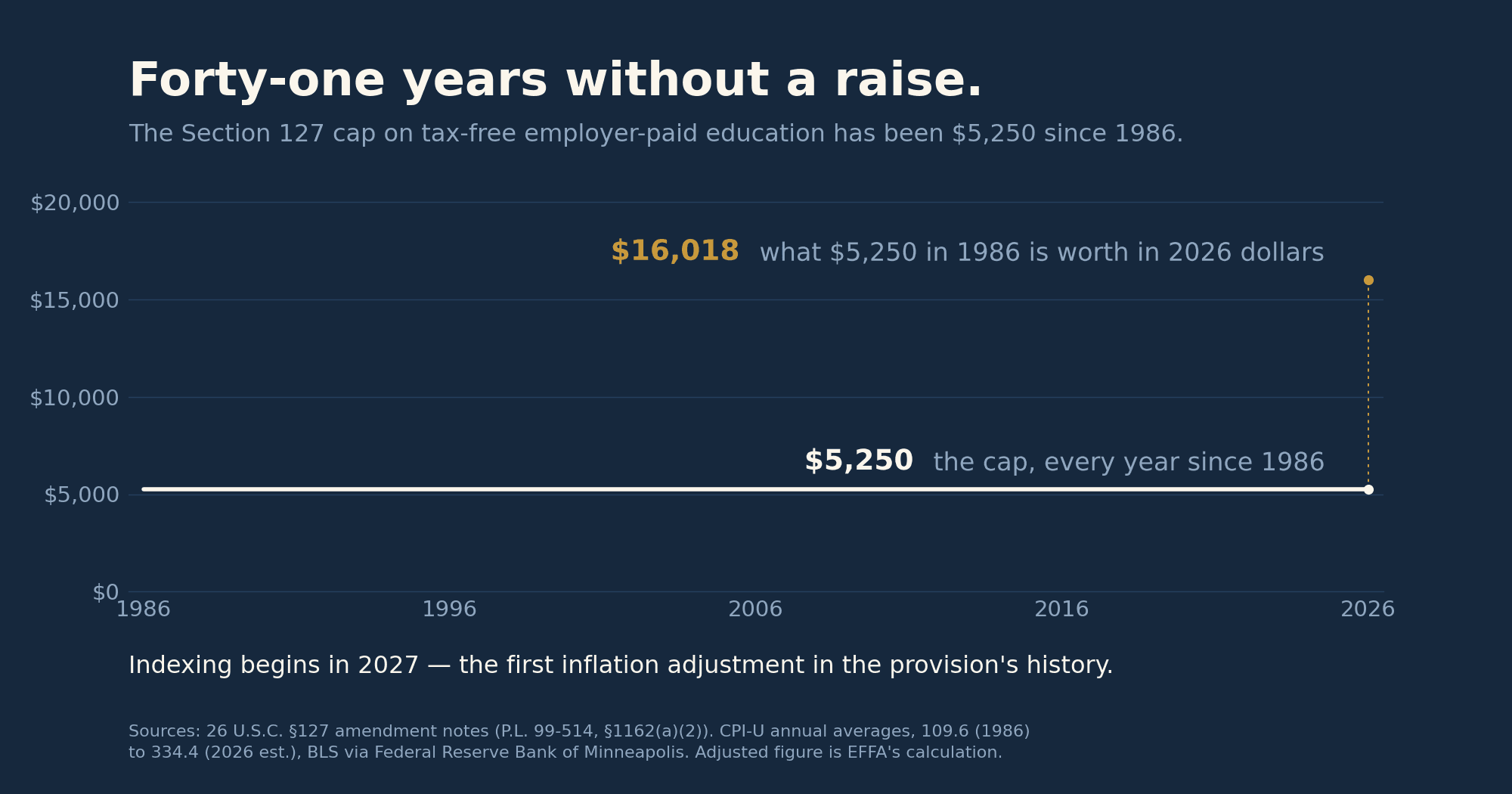
And Congress built the mechanism for it in 1978. Section 127 lets an employer pay for an employee's education, tax-free. There was no dollar cap at first. A $5,000 limit arrived in 1984, and $5,250 in 1986.
It has sat at $5,250, unindexed, for forty-one years. It finally adjusts for inflation beginning in 2027.
The entire provision costs the Treasury about $1.4 billion a year, according to the Joint Committee on Taxation. Against $1.1 trillion, that is a rounding error — which tells you how little of it is actually being used.
The money to retrain America already exists. It is just badly plumbed.
It is worth asking why nobody fixed the plumbing.
Not because nobody wanted to. Because the coordination cost was impossible. Thousands of employers, thousands of schools, each with its own terms, its own approval chain, its own billing office. Building the connective tissue between them by hand was never worth what it cost to build.
That stopped being true recently.
I want to be fair about this. Reimbursement was not stupid. It was the only affordable answer to a coordination problem that no longer exists.
But it is expensive now, and the people paying are the ones with the least to spare.
In the International Foundation of Employee Benefit Plans' survey of employers who offer tuition benefits, 69% required a minimum grade. 62% capped the annual amount. 57% included a clawback if you left. 51% required the coursework be job-related. 45% made you wait out a service period before you qualified at all.
So the employee pays the school. Waits for a grade. Files a claim. Waits again. And may owe the money back if they take another job.
The point is not the paperwork. It is who that design filters out. Anyone who cannot float a semester. Anyone who cannot risk owing it back. Which is precisely the person the benefit was written for in the first place.
I find it hard to describe that as a benefit. We built a system that asks the person with the least cushion to take the most risk, and then we call it generous. The people it works best for are the people who needed it least.
When the money does move, a great deal of it stops before it arrives.
In public-college contracts obtained by The Century Foundation, the terms that were not redacted showed one large intermediary taking between 23% and 50% of tuition revenue. Per-employee fees charged to employers are not disclosed publicly by any major administrator at all.
Meanwhile private nonprofit colleges are discounting an estimated 57.1% of first-time undergraduate tuition this year, up from 54.5% the year before. Only about a sixth of that institutional aid comes from endowment earnings or philanthropy. The rest is revenue they simply never collect.
Every dollar an intermediary takes is a dollar that could have been a discount.
We have spent more than two years building this and testing whether the model actually holds.
It does. Schools can formalize employer partnerships instead of negotiating each one from scratch. Employers can see and approve exactly what they are paying for before a dollar moves. Tuition can be billed directly to the employer, and the person doing the learning never fronts the cost.
That question is settled. What changes now is speed.
Two people helped me get EFFA off the ground — Jeff Nelder and Jeff Creighton. They are pursuing their own work now, we are still close, and I am glad that what they helped start is standing on its own.
We have built the bridge.
A school and an employer trying to do business today start from nothing. Every arrangement is negotiated from scratch, in whatever terms the last conversation happened to use. The work lives in one person's inbox and leaves when that person leaves. And when it is over, neither side can tell you what any of it produced.
So the bridge is three things.
A common language, so that terms mean the same thing on both sides of the table and a deal can be compared to the one before it.
A common process, so that the arrangement survives the person who made it.
One record, in real time, so that both sides can see what is actually happening instead of reconstructing it a year later.
Direct billing runs on it. The employer is billed, the school is paid, and the employee never fronts the cost.
That company is EFFA.
There are 37.6 million working-age Americans with some college and no credential. Most of them are working right now. A great many of them work somewhere that has already agreed to pay for the rest of it — and either does not know, or cannot reach it.
That is not a tragedy. It is a plumbing problem, and plumbing problems get fixed.
Fix it and the effects compound. People finish what they started. Employers get the skills they are short of instead of bidding for them. Schools fill seats they are currently buying at auction. And none of it arrives on somebody's credit report.
Nobody should have to borrow to become employable.
Charlie Nguyen is the founder of EFFA.
Sources
AI and employment for 22-to-25-year-olds, including the dispute — Stanford Digital Economy Lab, August 2026: https://digitaleconomy.stanford.edu/app/uploads/2026/08/Canaries_August2026.pdf
Yale Budget Lab on the interest-rate explanation: https://budgetlab.yale.edu/research/ai-probably-not-yet-reason-labor-market-weakening
Economic Innovation Group: https://eig.org/wp-content/uploads/2026/01/TAWP-Iscenko-Millet.pdf
Moody's negative-margin projection — Higher Ed Dive, November 21, 2025: https://www.highereddive.com/news/moodys-negative-outlook-higher-ed-2026/806097/
High schoolers, AI, and alternatives to college — EAB, February 25, 2026: https://eab.com/about/newsroom/press/ai-in-college-search-survey/
Certificate and four-year enrollment — National Student Clearinghouse Research Center, June 4, 2026: https://nscresearchcenter.org/final-spring-enrollment-trends/
Training spend per employee — ATD 2026 State of the Industry, May 19, 2026: https://www.td.org/content/atd-blog/2026-state-of-the-industry-report-indicates-latest-td-trends
WIOA Title I allotments — U.S. Department of Labor, Federal Register, May 19, 2025: https://www.federalregister.gov/documents/2025/05/19/2025-08879/program-year-py-2025-workforce-innovation-and-opportunity-act-wioa-title-i-allotments-py-2025-title
Student loan delinquency and transfers to the Default Resolution Group, Q1 2026 — Federal Reserve Bank of New York, May 12, 2026: https://www.newyorkfed.org/newsevents/news/research/2026/20260512
The $1.1 trillion education and training system, and the $407B / $590B split — Georgetown Center on Education and the Workforce, February 2015, using 2013 data: https://cew.georgetown.edu/cew-reports/college-is-just-the-beginning/
Section 127 statutory history and 2027 indexing — 26 U.S.C. 127 amendment notes: https://uscode.house.gov/view.xhtml?req=granuleid:USC-prelim-title26-section127&num=0&edition=prelim
Section 127 tax expenditure — Joint Committee on Taxation, JCX-48-24, December 11, 2024: https://www.jct.gov/getattachment/765709fb-9a4b-430a-8f9e-4d342ec97f7e/x-48-24.pdf
Conditions attached to tuition benefits — International Foundation of Employee Benefit Plans, Education Benefits 2019 Survey Results, reported October 9, 2019: https://blog.ifebp.org/ensure-tuition-reimbursement-doesnt-break-bank/
Intermediary revenue share in public-college contracts — The Century Foundation, February 7, 2022: https://tcf.org/content/commentary/employer-provided-tuition-benefit-programs-guild-good-gets/
First-time undergraduate tuition discount rate — NACUBO via Higher Ed Dive, June 1, 2026: https://www.highereddive.com/news/tuition-discount-rate-reaches-57-for-private-nonprofits-nacubo-says/821554/
How institutional aid is funded — NACUBO via Inside Higher Ed, June 1, 2026: https://www.insidehighered.com/news/business/revenue-strategies/2026/06/01/tuition-discounting-continues-climb
Working-age Americans with some college and no credential, measured at the start of the 2023-24 academic year — National Student Clearinghouse Research Center via Higher Ed Dive, June 4, 2025: https://www.highereddive.com/news/working-age-adults-with-some-college-but-no-credential-reaches-376m-repor/749703/
CPI-U annual averages used for the inflation adjustment — Federal Reserve Bank of Minneapolis: https://www.minneapolisfed.org/about-us/monetary-policy/inflation-calculator/consumer-price-index-1913-